

Thida Loy was a San Franciscan-born Chinese performer began dancing as a burlesque fan dancer in the 1930s. The earliest newspaper advertisements for Loy were in December 1935, though she could’ve been performing under a different name before.
When she started performing her own fan dance, she received the moniker “The Chinese Sally Rand of Hollywood”. Being compared to Sally Rand would follow her her entire career. The Oregon Daily Journal stated, “Thida Loy, said to be Sally Rand’s only rival from the Orient.” Thida Loy was a petite dancer in a league of her own. She created many more dance routines than other fan dancers of the time.
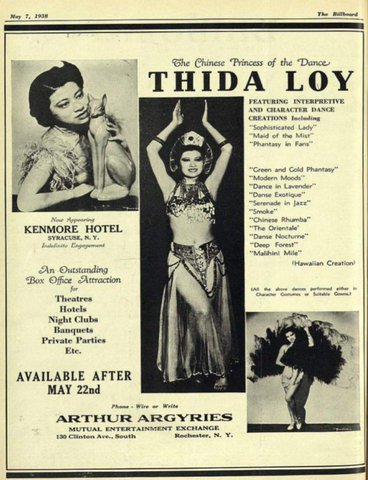
(The Billboard Magazine. US. Thida Loy. Page 2. May 7, 1938)
Featuring Interpretive and Character Dance Creations including:
“Sophisticated Lady”, “Maid of the Mist”, “Phantasy in Fans”, “Green and Gold Phantasy”, “Modern Moods”, “Dance in Lavender”, “Dance Exotique”, “Serenade in Jazz”, “Smoke”, “Chinese Rhumba”, “The Orientale”, “Danse Nocturne”, “Deep Forest”, and “Malihini Mele” (Mahlihini meaning ‘foreigner to a new place’ and Mele meaning ‘chant’ or ‘song’ in Hawaiian). By 1940, Loy had added several acts to her repertoire: “Death of the Butterfly”, “Songs of India”, and “Chino Soy”.
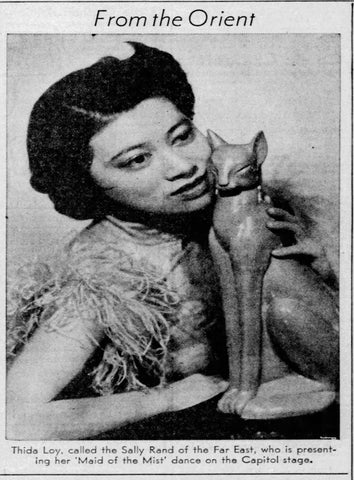
(The Oregon Daily Journal.”From the Orient.” Page 20. April 7, 1937)
Caption reads, “Thida Loy, called the Sally Rand of the Far East, who is presenting her ‘Maid of the Mist’ dance at the Capitol stage.”
The “Chop Suey Circuit”
The “Chop Suey Circuit” was a fascinating network of Asian American nightclubs that thrived in the mid-20th century, particularly from the 1930s to the 1950s. These venues, such as the famous Forbidden City in San Francisco, showcased Asian American performers in cabaret-style acts, including singing, dancing, and comedy. The circuit catered to predominantly white audiences, blending “Oriental” aesthetics with American entertainment styles to create a unique and exoticized experience.
The performers often adopted stage personas that played into stereotypes, such as being labeled the “Chinese Frank Sinatra” or in Thida’s case, “Chinese Sally Rand.” While this reflected the racial dynamics of the time, it also provided Asian Americans with opportunities to break into the entertainment industry and challenge prevailing stereotypes by demonstrating their talent and versatility.
The Chop Suey Circuit was not just about entertainment; it also played a role in shaping perceptions of Asian American identity and culture. It highlighted the tension between cultural assimilation and the preservation of heritage, as performers navigated the expectations of their audiences.

(The Wichita Eagle. Thida Loy. Page 3. February 19, 1940)
Loy performed her “oriental fan dance” at Mori’s Cafe (440 Broadway San Francisco, CA) three times nightly! She produced her own shows often, such as “Romance in Hawaii” where she acted as the Mistress of Ceremonies. She cast two other performers, Violet Meyers and Kay Sands, in the show. It featured native Hawaiian songs and dances–plus a “hula moderne”.
Car Accident & Court Case | 1936
On June 26, 1936 Thida filed a civil suit in San Francisco Municipal court against the Yellow Cab Company. She sued the company for $2,000 ($45,257.55 today) in damages after she was a passenger in a cab that halted suddenly. The jerk apparently injured her enough she had to stop dancing, which was bringing her $70 a week ($1,584.01 today). The conclusion of the trial was not reported on.

(The San Francisco Examiner. “A New Step–Into Court.” Page 32. June 27, 1936)
Loy continued to perform on theater stages and at conventions and stag parties across the United States.

(The Oregon Daily Journal. Advertisement for Thida Loy at the Capitol Theatre. Page 46. March 28, 1937)

(The Billboard Magazine. Advertisement for Thida Loy. US. August 13, 1938)

(The Oregon Daily Journal. Advertisement for Thida Loy at the Capitol Theatre. Portland, OR. Page 39. November 13, 1938)

(The San Francisco Examiner. Advertisement for Thida Loy at the Chinese Sky Room. Page 32. February 5, 1941)
Thida Loy in Nebraska | 1938
Loy was the featured attraction at the Rustic Inn in Scottsbluff, Nebraska. She had recently appeared at the Frontier Days in Cheyenne, Wyoming and performed at the Rustic Inn for two weeks.

(Scottsbluff Daily Star Herald. “Fan Dancer Featured.” August 19, 1938)
(Scottsbluff Daily Star Herald. Advertisement for Thida Loy at the Rustic Inn. August 19, 1938)
Caption reads, “Recently broke all records! Played before 50,000 people at Frontier Days Cheyenne, Wyo. She has thrilled thousands in America and Europe with her sensational dancing!”
(The Klamath News. Klamath Falls, OR. December 21, 1938)
The Young China Troupe | 1949
Thida Loy continued to perform throughout the 1940s where she traveled internationally to showcase her burlesque dances. In 1941 she was billed as a ‘peek-a-boo’ dancer. The last performance I could find was with the “Young China Troupe; America’s Greatest Chinese Show” at Club Oakland in March 1949.
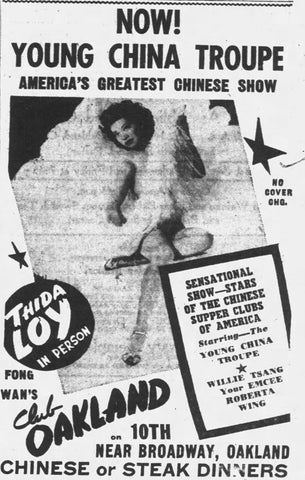
(Oakland Tribune. Oakland, CA. Advertisement for Thida Loy at Club Oakland. Page 5. March 12, 1949)
The performers at venues like Fong Wan’s Club Oakland, including Thida Loy, Roberta Wing, and Willie Tsang, were part of a vibrant era of Chinese American entertainment in the 1930s and 1940s. These artists often blended traditional Chinese cultural elements with modern showmanship, creating performances that captivated diverse audiences.
Thida Loy and Roberta Wing were likely dancers or singers who contributed to the allure of the nightclub scene. Willie Tsang, as the emcee, would have been the charismatic host, guiding the audience through the evening’s entertainment and adding a personal touch to the performances. These individuals were part of a broader movement where Chinese American entertainers challenged stereotypes and showcased their talent in glamorous settings.
Unfortunately, detailed historical records about these specific performers are scarce. However, their contributions to the cultural landscape of the time were significant, as they helped pave the way for greater representation and appreciation of Chinese American artistry in mainstream entertainment. After 1949, it seems Thida Loy retired from dancing or began performing under another name. She could’ve retired and faded into anonymity.
Chinese Fan Dancers in 1930s America
In the vibrant tapestry of 1930s American entertainment, Chinese fan dancers emerged as captivating figures who bridged the gap between traditional cultural expression and modern showmanship. This period marked a time of innovation and resilience for Asian American performers, particularly in iconic venues like San Francisco’s Forbidden City and Club Shanghai. These performers transformed the stage into a canvas, weaving together the elegance of Chinese dance with the glamour of contemporary cabaret.
The use of fans as props was both aesthetic and symbolic. Dancers created intricate, fluid patterns, evoking elements of traditional Chinese art and storytelling. Their performances, however, were far from static; they blended these influences with elements of jazz-age choreography, drawing audiences into a world of motion and color. For many, these acts represented a reimagining of cultural identity—an assertion of pride and creativity in an era when Asian Americans faced significant social and cultural challenges.
Chinese fan dancers also played a key role in shifting public perceptions. In a time when stereotypes of Asian Americans were widespread, these performers defied rigid narratives by showcasing their talent, versatility, and individuality. The burgeoning nightclub scene became not just an escape but also a platform for empowerment. Fan dancers like Thida Loy and Noel Toy, often referred to as the “Chinese Sally Rand,” exemplified how these artists navigated and shaped their identities in the limelight, becoming icons of their time.
Today, the legacy of Chinese fan dancers offers a rich window into the intersections of culture, identity, and performance during the 1930s. Thida Loy’s artistry wasn’t just about entertainment—it was about pushing boundaries and reimagining the role of Asian Americans in a rapidly changing society.
A Note on Asian American Burlesque Dancers
Asian American burlesque performers have made significant contributions to the art form, blending cultural influences with bold creativity. Some notable burlesquers include:
- Coby Yee: Known as the “China Doll,” Coby Yee was a trailblazing performer and producer in San Francisco’s burlesque scene during the mid-20th century. Her elaborate costumes and captivating performances made her a standout star.
- Tura Satana: Famous for her role in the cult film Faster, Pussycat! Kill! Kill!, Tura Satana was also a burlesque performer who brought fierce energy and charisma to the stage.
- Lana Wong: Another prominent figure, Lana Wong dazzled audiences with her performances that challenged stereotypes and showcased her talent.
- Sukki Singapora: A contemporary performer, Sukki Singapora is known for her activism and artistry, blending traditional Asian aesthetics with modern burlesque.
Sources
- Oakland Tribune. Oakland, CA. Advertisement for Thida Loy at Club Oakland. Page 5. March 12, 1949
- The Klamath News. Thida Loy. Klamath Falls, OR. December 21, 1938
- Scottsbluff Daily Star Herald. Advertisement for Thida Loy at the Rustic Inn. August 19, 1938
- Scottsbluff Daily Star Herald. “Fan Dancer Featured.” August 19, 1938
- The San Francisco Examiner. Advertisement for Thida Loy at the Chinese Sky Room. Page 32. February 5, 1941
- The Oregon Daily Journal. Advertisement for Thida Loy at the Capitol Theatre. Portland, OR. Page 39. November 13, 1938
- The Billboard Magazine. Advertisement for Thida Loy. US. August 13, 1938
- The Oregon Daily Journal. Advertisement for Thida Loy at the Capitol Theatre. Page 46. March 28, 1937
- The San Francisco Examiner. “A New Step–Into Court.” Page 32. June 27, 1936
- The Wichita Eagle. Thida Loy. Page 3. February 19, 1940
- The Oregon Daily Journal.”From the Orient.” Page 20. April 7, 1937
- The Billboard Magazine. US. Thida Loy. Page 2. May 7, 1938
- The Wichita Beacon. “Pfizzlewinks Dancer.” Princess Thida Loy dressed for her Veil Dance. Page 5. February 20, 1940
- Nevada State Journal. Advertisement for Thida Loy at the Dog House. Page 2. May 5, 1939
- Nevada State Journal. Advertisement for Thida Loy at the Dog House. Page 2. July 17, 1940
- The Oregon Daily Journal. Advertisement for Thida Loy at the Capitol Theatre. Portland, OR. Page 10. March 30, 1937
- The San Francisco Examiner. “Mori’s.” Page 18. May 23, 1936
- The San Francisco Examiner. “Mori’s.” Page 18. June 6, 1936
- The San Francisco Examiner. “Dancer Asks $2,000.” Page 32. June 27, 1936
- The Oregon Daily Journal. “Fan Dancers From Orient Coming to Capitol.” Page 5. March 27, 1937
- The Oregon Daily Journal. “From the Orient.” Page 20. April 7, 1937
- Scottsbluff Daily Star Herald. “Fan Dancer Featured.” August 19, 1938
- The Oregon Daily Journal. “Magic Stunts At Capitol Intriguing.” Ken Madden. Page 11. November 8, 1938
- University Place News. “Mendell Spends Summer Vacation Singing On KGKY, In Night Clubs.” Jeanne Souser. September 22, 1938
- Lansing State Journal. “Three Good Acts on Deerhead Bill.” Page 16. September 29, 1939
- The Wichita Beacon. “Chinese ‘Sally Rand’ to Dance at Stag Frolic.” Page 5. February 16, 1940
- The Wichita Beacon. “Pfizzlewinks Dancer.” Page 5. February 20, 1940
- The Wichita Beacon. “Chinese Sally Rand of Hollywood.” Page 3. February 19, 1940
- The San Francisco Examiner. Page 30. October 30, 1942
- The Oakland Post Enquirer. Page 8. February 5, 1949
- https://blogs.cornell.edu/asianammedia/2018/12/04/forbidden-city/
- https://en.wikipedia.org/wiki/Forbidden_City_%28nightclub%29
- https://www.messynessychic.com/2022/03/23/behind-the-curtain-of-the-1940s-chinatown-nightclubs-that-shattered-asian-stereotypes/
- https://burlesquehall.com/exhibition/remodeling-minority-asians-and-asian-americans-in-burlesque/


Leave a comment