

The Hot Mikado was a 1939 musical adaptation of Gilbert and Sullivan’s comic opera The Mikado (1885). Produced by Mike Todd, it featured an all-African-American cast and brought a jazz-infused twist to the original work. The production starred the legendary Bill “Bojangles” Robinson as the Mikado and included vibrant musical arrangements by Charles L. Cooke. Known for its extravagant costumes and lively performances, it premiered on Broadway at the Broadhurst Theatre and later became a hit at the 1939–1940 New York World’s Fair. Although The Hot Mikado was not a striptease burlesque show, I found it worth mentioning the production in the canon of burlesque.

(NYPL Digital Archives. Bill Rose Theatre Division. The Hot Mikado. 1939)

(NYPL Digital Archives. Bill Rose Theatre Division. The Hot Mikado. 1939)
It ran for 85 performances on Broadway before moving to the 1939 New York World’s Fair. There the show was produced on a larger scale–a 60ft. stage instead of 38ft allowed for 150 actors–and to huge success. The stage was raised 7ft. so the audience could watch Robinson’s footwork. The show played four times a day, seven days a week at the World’s Fair! Two numbers were changed, “The Sun and I” and “Were You Not To Ko-Ko Plighted”, to swing numbers. An additional number for Robinson was created called “Thirty-Nine Years From Now,” where Robinson would show how he would dance at 100 years old.
Most patrons paid only 40 cents a seat to watch the show. It opened on June 22nd to 1,500 guests. On August 1, the Mikado hit 200 performances (including their Broadway run). The contract Robinson and his investor, Michael Todd, had signed with the Fair did not provide financial stability. In fact, the show lost money throughout the Fair run. According to David Cope, a World’s Fair Historian, the contract listed a seven-day work week which included time and a half pay for overtime and additional performances. Principal artists received $50.00/day ($1,147.78 in today’s buying power) and $45.00/day ($1,033 in today’s buying power) for the chorus. Unfortunately, by the end of the Fair, the production had lost close to $1 million.

(NYPL Digital Archives. Bill Rose Theatre Division. The Hot Mikado. 1939)
The show was celebrated for its innovative blend of traditional operatic elements with jazz, blues, and swing music, making it a standout production of its time. It also competed with another adaptation, The Swing Mikado, which added to its historical significance.
The Swing Mikado | 1938
The Swing Mikado (1938) was produced by the Federal Theatre Project in Chicago and featured an all-Black cast. This adaptation of The Mikado reimagined the setting as a tropical island and incorporated swing-style music, lively dances like the Truck and the Cakewalk, and modernized elements while retaining much of the original operetta’s dialogue and music. It aimed to appeal to contemporary audiences with its vibrant energy and jazz influences. However, some rewrites of the text, including imitations of Black dialect, led to criticism for perpetuating racial stereotypes. Despite these issues, the show was a success, transferring to Broadway, where it ran for 86 performances.

(“The Three Maids” from The Swing Mikado. 1938, Chicago. River Campus Libraries)
The key differences between the Hot Mikado & the Swing Mikado are their scope and focus. The Swing Mikado was a simpler, federally funded project with a more modest approach, while The Hot Mikado was a lavish production designed to dazzle audiences. Both adaptations, however, showcased the creativity and talent of Black performers, offering innovative reimaginings of Gilbert and Sullivan’s classic operetta.
Costuming and Set Design
The costuming for Hot Mikado was a visual feast, designed by Nat Karson, who was celebrated for his bold and imaginative approach. The costumes combined traditional Japanese-inspired elements with the glitz and glamour of 1930s fashion. For instance, Rosa Brown’s iconic outfit—a winged dress with a train and a massive hat—was so elaborate that it reportedly weighed 35 pounds!
Karson’s designs were vibrant, colorful, and theatrical, reflecting the jazz and swing influences of the production. His work was so well-received that he was named “the season’s best costumer” by critic George Jean Nathan.
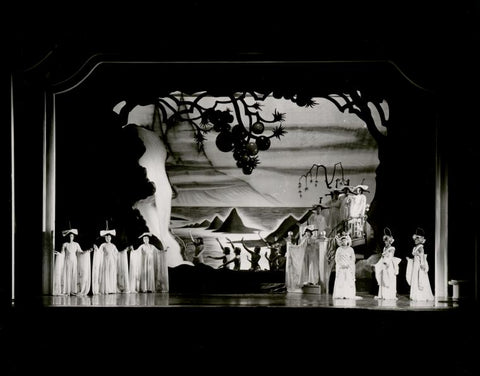
(NYPL Digital Archives. Bill Rose Theatre Division. The Hot Mikado. 1939)

(NYPL Digital Archives. Bill Rose Theatre Division. The Hot Mikado. 1939)
Additionally, Karson’s original costume designs, painted with gouache on illustration board, are preserved and provide a glimpse into the creative process behind the production. These designs highlight the intricate details and bold choices that made the costumes a standout feature of the show.

(The Hot Mikado Costumes. 1939)
Bill “Bojangles” Robinson | 1878-1949

(Bill “Bojangles” Robinson. The Hot Mikado. 1939)
Bill “Bojangles” Robinson was a legendary American tap dancer, actor, and singer, born on May 25, 1878, in Richmond, Virginia. He became one of the most celebrated and highest-paid Black entertainers of the early 20th century.
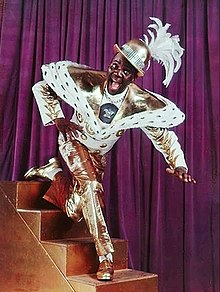
(Bill “Bojangles” Robinson on Stairs. Publicity Shot for the Hot Mikado)
Robinson was renowned for his innovative tap dancing style, which brought a lightness and elegance to the art form. His signature “stair dance,” where he tapped rhythmically up and down a flight of stairs, became iconic. He also broke racial barriers in entertainment, being one of the first Black performers to appear without blackface makeup and to perform solo in vaudeville, defying the “two-colored” rule that required Black performers to appear in pairs.
He gained widespread fame for his on-screen partnership with Shirley Temple in the 1930s, starring in films like The Little Colonel. Despite criticism for perpetuating racial stereotypes in some roles, Robinson used his influence to advocate for civil rights, such as lobbying for equal treatment of Black soldiers during World War II and helping integrate public events.
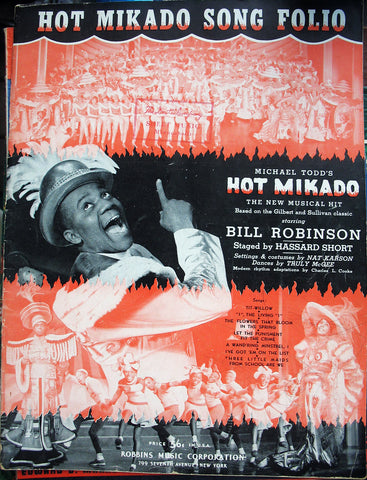
(The Hot Mikado Song Folio. 1939)
Robinson’s contributions to dance and entertainment left a lasting legacy, inspiring future generations of performers. He passed away on November 25, 1949, but remains a celebrated figure in American cultural history.
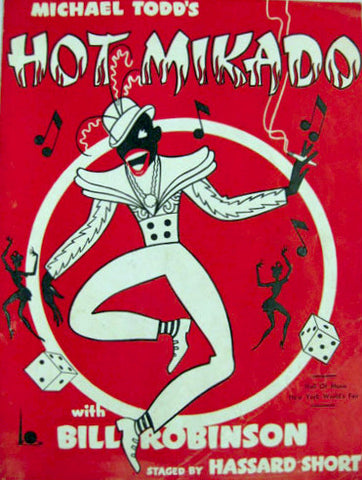
(The Hot Mikado Poster. 1940)
The Hot Mikado at the Paramount Theatre (aka Rose Theater) | 1940
After their second season at the New York World’s Fair, the production went on tour and appeared for one night only in Omaha, Nebraska. It played at the Paramount Theatre on March 12, 1940 to almost 3,000 people. The show was sponsored by the Omaha Drama League. The Omaha papers listed Rose Brown, who played Katisha, as being influenced by Mae West, and Bill Robinson as a man “with energy of someone half his age.”
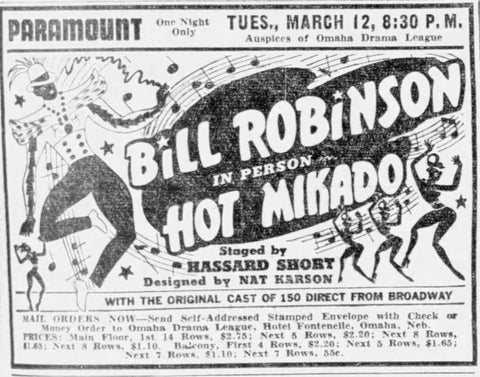
(Morning World Herald. Paramount Theatre Advertisement. March 3, 1940)

(Omaha World Hearld. “At 61, Bill Robinson Has Pep of Man Half His Age.” Page 40. March 10, 1940) [Photo caption states, “Maurice Ellis as Pooh-Bah in ‘Hot Mikado.”]
The Black Mikado | 1975
The 1975 Black Mikado was a vibrant adaptation of Gilbert and Sullivan’s The Mikado, set on a Caribbean island instead of Japan. This production featured a nearly all-Black cast and reimagined the original score with rock, reggae, blues, and calypso influences. The costumes blended Caribbean and African styles with pseudo-Japanese elements, creating a unique visual aesthetic.

(Poster of The Black Mikado. 1975. River Campus Libraries Collection)
The show amplified the underlying themes of sensuality and humor from the original opera, adding a modern and dynamic twist. It premiered at the Cambridge Theatre in London, running for 472 performances before touring internationally. The production was praised for its creativity and bold reinterpretation of a classic work.
The Hot Mikado | 1986
The 1986 version of Hot Mikado was a vibrant reimagining of Gilbert and Sullivan’s The Mikado, adapted by David H. Bell and Rob Bowman. This production retained the original plot but infused it with 1940s American aesthetics, blending Japanese-inspired designs with zoot suits, neon lights, and swing-era fashion. The music was reorchestrated to include jazz, blues, gospel, and swing, giving the classic score a modern and energetic twist.
The show premiered at Ford’s Theatre in Washington, D.C., and was praised for its lively choreography, colorful costumes, and innovative approach to a traditional operetta. It has since been revived multiple times, showcasing its enduring appeal as a creative and entertaining adaptation.
The Cultural Significance of The Hot Mikado
The Hot Mikado holds a unique place in cultural history as a groundbreaking adaptation that bridged traditional operetta and contemporary African-American musical styles of the 1930s. Its significance lies in several key areas:
- Representation and Innovation: By featuring an all-African-American cast, Hot Mikado celebrated African-American artistry during a time when opportunities in mainstream theater were limited. It showcased the immense talent of performers like Bill “Bojangles” Robinson and brought jazz, swing, and blues to a broader audience.
- Cultural Fusion: The production reimagined Gilbert and Sullivan’s The Mikado through the lens of 1930s American culture, blending Victorian satire with the vibrant energy of Harlem Renaissance-inspired music and dance. This fusion highlighted the adaptability of classic works to new cultural contexts.
- Impact on Musical Theater: Hot Mikado demonstrated how traditional operettas could be modernized to appeal to contemporary audiences, paving the way for future reinterpretations of classic works. Its success also underscored the growing influence of African-American music and performance styles on American theater.
- Historical Context: Premiering at the 1939 New York World’s Fair, Hot Mikado reflected the optimism and creativity of the era, even as it subtly addressed themes of racial and cultural identity through its innovative approach.
The production remains a testament to the power of artistic reinvention and the enduring relevance of cross-cultural collaboration!
Sources
- http://www.1939nyworldsfair.com/Ponderings/HotMikado.aspx
- https://en.wikipedia.org/wiki/The_Hot_Mikado_%281939_production%29
- https://www.youtube.com/watch?v=LQ-CcPIU2MY
- https://www.youtube.com/watch?v=osDQk2Egygo
- https://www.youtube.com/watch?v=3AVHrPAlCcI
- https://www.smithsonianmag.com/smart-news/bill-robinson-king-of-tap-180963332/
- https://www.thefamouspeople.com/profiles/bill-robinson-11503.php
- https://archives.nypl.org/the/22123
- https://rbscpexhibits.lib.rochester.edu/exhibits/show/mikado_and_race/intro_commentary

Leave a comment