

Nestled in the heart of the Midwest, Beatrice, Nebraska, might not be the first place that comes to mind when one thinks of burlesque. However, like many small towns across America, Beatrice, has its own unique story to tell when it comes to entertainment history. Burlesque, with its blend of theatricality, humor, and daring performances, brought glimmers of glamour and rebellion to even the smallest corners of the country.
In this post, we’ll explore the surprisingly fascinating intersection of burlesque and Beatrice, shedding light on a lesser-known facet of this charming town’s cultural past. Let’s uncover how this spirited art form wove itself into Beatrice’s story!
Early Beginnings – Opera Houses
In the late 19th and early 20th centuries, opera houses were cultural hubs in many American towns, including those in Nebraska. These venues were not exclusively for opera but hosted a variety of performances, from plays and musical acts to lectures and community events. They were often grand buildings, reflecting the aspirations of the towns they served.
Diller Opera House
In Beatrice and surrounding areas, opera houses like the Diller Opera House and others became focal points for entertainment and social gatherings. These spaces brought a touch of sophistication and artistic expression to rural communities, serving as a bridge between small-town life and the broader cultural movements of the time. Their legacy remains a testament to the importance of the arts in shaping community identity.
The Walters’ Opera Burlesque Company
The Walters’ Opera Burlesque Company performed at the “Opera House” (no distinction given by the author of the newspaper) in October 1890. The Company had initially missed their train from York, NE and arrived late for their performance at the Opera House, according to the Beatrice Daily Express. Walters’ presented a new operatic burlesque called “Loo-Lah” or “My Son’s a Daughter.”
The company was comprised of women who played all roles regardless of gender. The papers raved about the sparkling music and elegant costumes, along with a soubrette called Miss Sargent, who executed an artistic “skirt dance.” The company also included two comedians named Menter and Doran. Mr. Walters, the company director, was a tenor who charmed the audience when he appeared singing in the chorus.
The Paddock Opera House
The Paddock Opera House was another venue in Beatrice. On March 3, 1893, the famous Al. G. Field’s Minstrels performed there. They performed a comedic burlesque and an acrobatic act. A juggler called “Eldora”, nicknamed the American Cinquevalli, was featured in the act. This nickname is referencing a German performer, Paul Cinquevalli.
A Note on Paul Cinquevalli (1859-1918)
Paul Cinquevalli was a famous juggler and entertainer of the late 19th and early 20th centuries. Born in 1859 in what is now Poland, he gained fame for his extraordinary juggling skills and innovative performances. Cinquevalli was known as one of the first “gentleman jugglers,” using everyday objects like bottles, plates, and umbrellas in his acts.

His career began in gymnastics, but after a trapeze accident, he transitioned to juggling. He performed across Europe and America, captivating audiences with his feats of balance and dexterity. Cinquevalli’s acts often included impressive tricks, such as balancing a chair in his teeth while juggling balls. Despite his success, his career was affected by World War I due to his German heritage, and he retired shortly after. He passed away in London in 1918.

The Lyric Theatre – 1893-1976

The history of the Lyric Theatre in Beatrice, Nebraska, reflects its transformation over time. Initially, it was mentioned as the Auditorium in a 1893 article in the Beatrice Daily Times. The first burlesque show at the Auditorium was on Thursday March 16, 1893, when May Davenport and her “City Sports Burlesque Co.” performed. The company was advertised as “Beautiful Women, Fascinating Faces, Finest Formed Women on the American Stage.”

The venue later became the Lyric Theatre, opening on May 2, 1907. In October 1909, the Lyric Theatre hosted Rosa & Green as they produced a burlesque on The Merry Widow Opera they called “Mixed Affairs.” Early programs included moving pictures and illustrated songs, enhanced by innovative technology like the Kinderome and, in 1913, the Edison Kinetephone. The Kinetephone was the combination of Edison’s Kinetoscope and a phonograph for music. In 1915, Nelson and Hansen, managers of the Jewel Theatre, took over management the Lyric Theatre.
The Elks Lodge acquired the building in 1922, renovating it with plans by architect R.W. Grant. The Lyric Theatre primarily served as a lodge and meeting hall afterward and ceased regular advertising alongside other local theaters. By September 1930, it was referred to as the former Lyric Theatre, with the Elks burning the mortgage. The Elks vacated the building in 1976, and the site eventually became a parking lot near the police department. This piece of history encapsulates the evolution of cultural and community spaces in Beatrice.
Rosita Royce in Beatrice

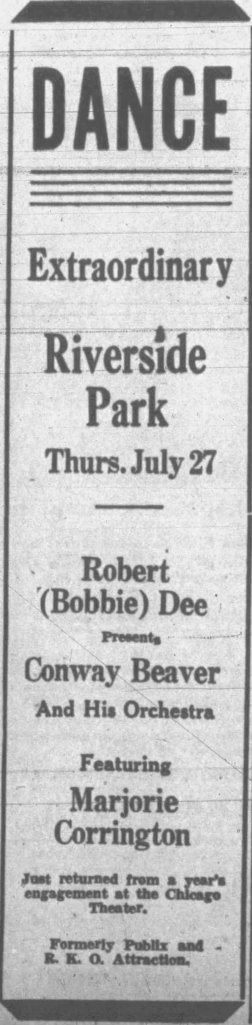
In July of 1933, Marjorie Corrington AKA Rosita Royce performed at the Riverside Park in Beatrice. She had just finished a year’s engagement at the Chicago Theater, performing her fan dance and bubble dance. Rosita was a Nebraska-born burlesque dancer who grew to become a famous dancer during the 1940s and 50s.

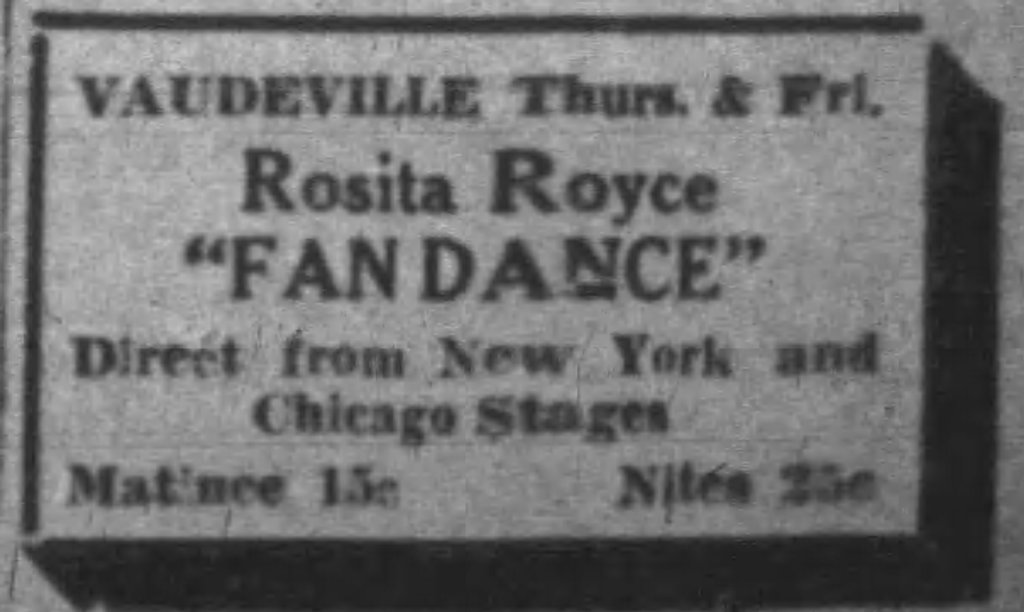
In January 1934, Rosita Royce performed her Fan Dance in Beatrice. She had just come off of a tour of New York City and Chicago with raving reviews! She would go on to invent the Dance of the Doves, which she took the New York World’s Fairs in 1939 and 1940.

Jansen Hotel Steak House – 1966
The Jansen Hotel Steak House was a club and restaurant that frequently had exotic dancers, topless entertainers, and oriental dancers, mostly from 1966-1969. In November 1966, Princess Aisha a “Lovely Oriental Dancer” performed at the Steak House. They served fried chicken “picnic style.” In December of the same year, Johnny Ray Gomez sang with the oriental dancer Zsi-Zsi Buray. Then in 1969 they hosted a topless Go-Go girl show with swing dancers.
A Note on Zsi-Zsi Buray
Zsi-Zsi Buray was a belly dancer who gained recognition for her captivating performances and unique style. She even served as a guest speaker at an Iowa school, showcasing her versatility beyond the stage. Her contributions to the art of dance highlight the cultural significance and expressive power of belly dancing.
The Fireside Lounge at the Saida Inn – 1960s-70s
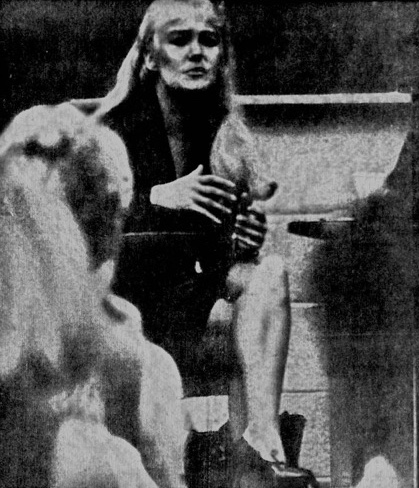
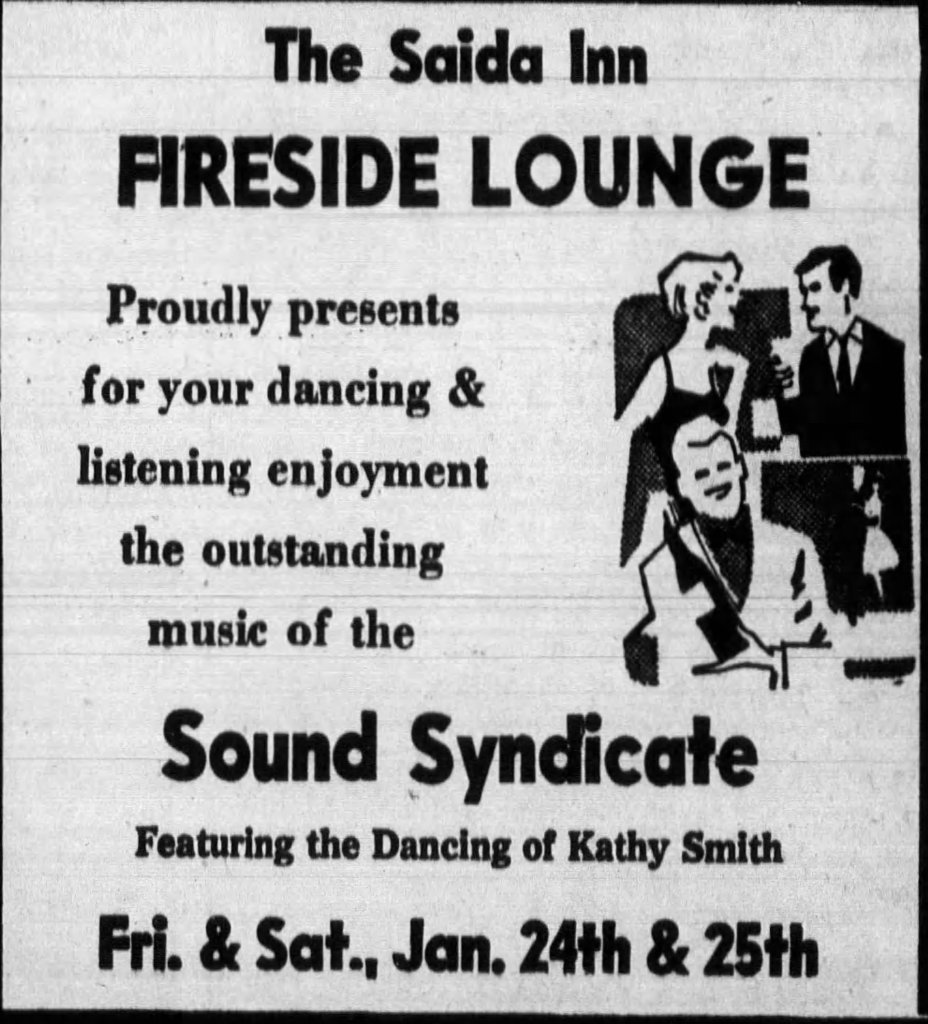
The Saida Inn had a supper club called the Fireside Lounge. It employed topless go-go dancers in the 1960s. But by 1971, bands had replaced the dancers.
Go-go dancing, particularly in its more risqué forms like nude and semi-nude performances, became a cultural and economic phenomenon in the 1960s and 70s. These performances were often featured in nightclubs and bars, drawing in large crowds eager for the lively, rebellious energy of the era. All over Nebraska, the allure of go-go dancers, combined with the increased nightlife scene, significantly boosted business for venues that embraced this trend. It wasn’t just about the dancing—it was the atmosphere of freedom and counterculture.
Gatsby’s Lounge – 1980s
Gatsby’s Lounge was located at 415 Court Street and was owned by Gary T. Thompson. Thompson also owned the Coachman Restaurant and Lounge. Gatsby’s employed topless go-go dancers. The Lounge applied for a liquor license which started a domino effect in Beatrice. In December 1980, the Beatrice City Council took action against the club and it’s topless dancing. The council voted 5-2 to recommend approval of the club’s liquor license but also drafted a city ordinance that would prohibit nude or semi-nude dancing within the “Central Business District.”
Banning Nude & Semi-Nude Dancing – 1981
The Beatrice City Council banned nude and semi-nude dancing in establishments selling alcohol. This began by recommending the Liquor Control Commission prohibit liquor establishments within the Central Business District from receiving liquor licenses if they had nude or semi-nude dancing. This was withdrawn and instead an ordinance was drafted prohibiting nude and semi-nude dancing in the Central Business District.
American Legion Club – 1982
The Beatrice chapter of the American Legion Club, located at 7th and Dorsey Streets, hosted a “Mixed Stag” Party on Tuesday November 9th from 6:30pm-9:00pm. They served turkey fries and ham “with all the trimmings including salad.” Mixed stag parties, combining bachelor and bachelorette celebrations, were not commonly advertised publicly in the 1980s. These events were typically private gatherings organized by friends and family. However, nightlife venues and clubs during that era often hosted themed parties or events showcasing strippers and blending diverse groups for lively celebrations.
The Pub – 1980s
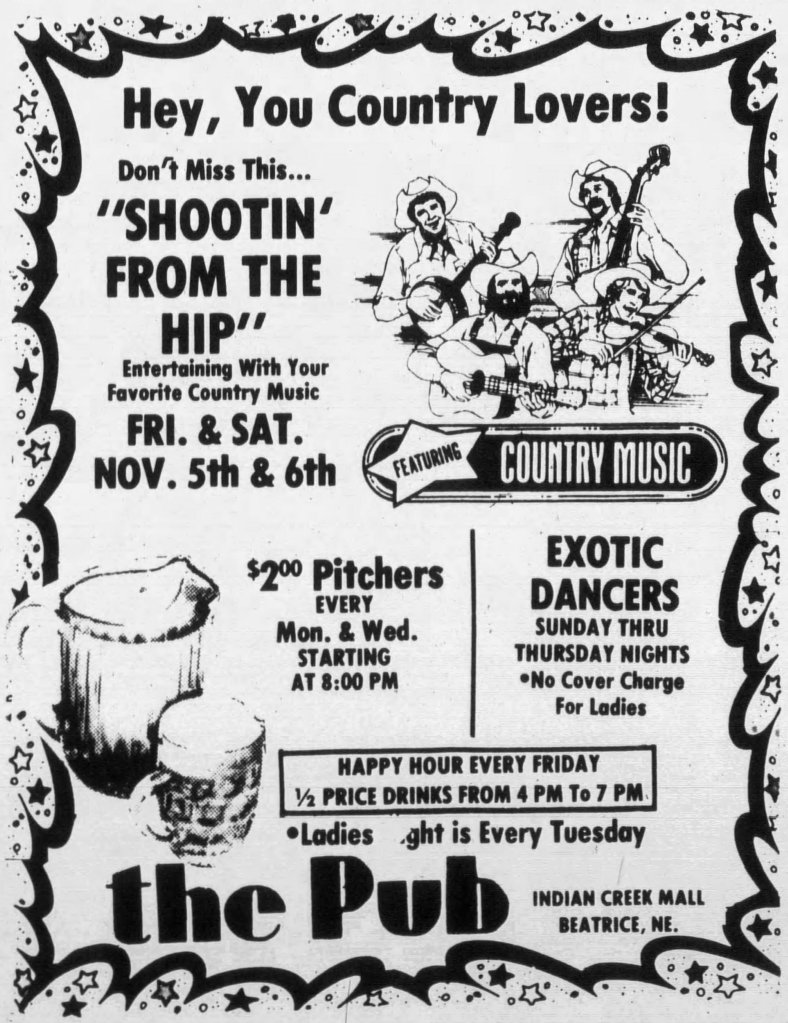
The Pub was a country bar located in Indian Creek Mall. They featured topless or “exotic” dancers and various country bands throughout the early 1980s. They advertised:
- Exotic dancers Sunday thru Thursday nights
- 2 dancers nightly
- New dancers each week
- Ladies’ Night every Tuesday evening
- No cover charge for ladies

Beatrice Burlesque
Beatrice, Nebraska, stands as a testament to the charm and intrigue of small-town burlesque. While larger cities may have dominated the spotlight of this expressive art form, towns like Beatrice have woven their own stories into the tapestry of burlesque history. Whether through community-led performances or gatherings that celebrate artistry, Beatrice encapsulates the vibrancy and allure of burlesque in an intimate, local setting—proving that even in the quietest corners, the art of storytelling, dance, and theatrical flair can flourish.
Sources
- Cinema Treasures; The Lyric Theatre; Beatrice, NE: https://cinematreasures.org/theaters/47327
- https://www.smithsonianmag.com/smithsonian-institution/juggling-genius-paul-cinquevalli-180964874/
Newspapers:
- Beatrice Daily Sun. Ad for Mixed Stag Party on November 9th. November 4, 1982
- Beatrice Daily Sun. “Public Notices.” Page 8. January 10, 1981
- Beatrice Daily Sun. Ad for Rosita Royce at the Beatrice Theatre. Page 5. January 15, 1934
- Lincoln Journal Star. “Beatrice council wants topless-dance ordinance.” Dean Terrill. Southeast Nebraska Bureau. Page 15. December 16, 1980
- Beatrice Daily Sun. Jansen Hotel Steak House Ad for Princess Aisha. Page 2. November 25, 1966
- Beatrice Daily Sun. Jansen Hotel Steak House Ad for The Royal Hawaiians. Page 2. December 13, 1966
- Beatrice Daily Sun. Jansen Hotel Steak House Ad for Topless Go-Go Girl show. Page 7. January 5, 1969
- The Beatrice Daily Express. “Walters’ Opera Burlesque Co.” October 31, 1890
- Beatrice Daily Sun. Ad for Marjorie Corrington (AKA Rosita Royce) at Riverside Park. Page 5. July 26, 1933
- Omaha World Herald. “‘The Day of the Hick Farmer Is Gone’ So Outstate Nebraska Goes Go-Go.” Don Pieper. Page 57. October 20, 1971
- Beatrice Daily Sun. Ad for Exotic Dancers at the Pub. February 10, 1983
- Beatrice Daily Sun. Ad for Exotic Dancers at the Pub. March 11, 1982
- Beatrice Daily Sun. Ad for Exotic Dancers at the Pub. November 4, 1982
- Beatrice Daily Sun. Ad for Exotic Dancers at the Pub. September 9, 1982
- Beatrice Daily Sun. Ad for Exotic Dancers at the Pub. March 23, 1982
- Beatrice Daily Sun. Ad for Mixed Stag Party at VFW Club. February 10, 1983
- The Beatrice Daily Times. Ad for May Davenport, City Sports Burlesque Co. at the Fifth St. Auditorium. Page 1. March 16, 1893
- The Beatrice Daily Express. “Late Local News.” Late Local News. Page 1. October 14, 1909
- The Beatrice Daily Express. “Al. G. Fields Minstrels.” Page 1. February 27, 1893

Leave a comment