

Long before Des Moines embraced its modern burlesque revival, the city played host to a vibrant, complicated legacy of tease and spectacle stretching from the 1860s to the 1940s. In opera houses, dime museums, and vaudeville theaters, performers—some celebrated, others scandalized—brought risqué humor, dance, and satire to Iowa’s capital. This post traces the evolution of early burlesque in Des Moines, spotlighting the venues, touring acts, and local controversies that shaped its rise, decline, and cultural imprint. It’s a story of shifting morals, showbiz resilience, and the Midwest’s flirtation with the bawdy and bold.
1860s-1900
The Lisa Weber Troupe performed at Moore’s Hall in April 1871. The Des Moines Register reported it was ‘side-splitting’ and a beautiful burlesque of La Somnambula was performed “with strength” from the entire cast. The leader, Miss Weber, was charming in her acting and songs. Moore’s Hall was overflowing with audience members, over a hundred unable to find seats. The company then produced the Burlesque of Pluto, or the Magic Lyre.
Grand Opera House

“La Fonte’s Serenaders and Blonde Burlesque Troupe” performed at the Des Moines Grand Opera House in November 1871. The company was composed of 14 actresses (10 of them blonde) and four African American minstrels.
In March 1874, the Chapman Troupe or the Chapman Sisters came to Des Moines. The newspaper noted their attractive voices and frolicking dances. The sisters, Blanche and Ella, were gorgeous, but Ella was the “universal favorite.” They performed local hits and presented a ‘travesty’ called “Lotus and Leo”.

The Adah Richmond American Burlesque Company performed at the Des Moines Grand Opera House in September 1885. They performed “The Sleeping Beauty”, “The Bartholdt Statue”, “Liberty Enlightening the World”, and “A Grand Zouave Drill by 30 Beautiful Girls.” The company was managed by Fred S. Mordaunt.
The Academy of Music
The Academy of Music hosted many burgeoning burlesque shows, which were often more aligned with satirizing popular operas of the day.

Audiences at the Academy saw Alred J. Knight and his Historical Costume Impersonations in 1879 and burlesque operettas like “Our Goblins” or burlesques on “Pinafore” by the Mr. William Gill and Company.
Foster’s Opera House – Drag King

Katie Emmett and her “Company of Players” were the main attraction at the Foster’s Opera House in March 1896. They presented “Chat – An American Boy” with Katie Emmett herself playing the boy “Chat.” It was common at this time for burlesque troupes to consist of mostly women, where women played all roles, regardless of the character’s gender.
Des Moines Street Fair
On October 17, 1898, Des Moines hosted the “Seni-Om-Sed” Carnival that gained notoriety after the Ministerial Association condemned all shows there. It featured many obscene shows along the midway.
The Omaha Daily Bee picked up the story and wrote, “Midway shows as carnival features were condemned by the Ministerial association of this city. During the annual Seni-Om-Sed Carnival here week before last on several of the cross streets adjoining the street fair, midway shows of a sensational character like the Orange Blossoms fake sensation and the Oriental Dancers were run under the sanction of the carnival management, which in fact had secured them.” – Omaha Daily Bee. “Iowa Men Well Cared For.” Page 8. October 18, 1898
1900s-1910s
Public Morality Challenged
In December 1909, Foster’s Opera House hosted a performance of the comedy “The Girl from Rector’s,” which came under fire for challenging public morals. The Des Moines Ministerial Association had “tipped” off the public morals committee.
The Ministers pushed for an investigation of the “burlesque houses” in Des Moines, with hope of having indictments returned. The Committee had hoped the law would swoop down on managers, but it gave Foster’s manager the leg up on counteracting their negative press.
William Foster, the proprietor of Foster’s Theatre/Opera House and the Grand Theatre, declared that before any show is permitted on his stage, he goes over the lines thoroughly and eliminates any questionable scenes and lines. The show included a “Dance of Salome” which offended the ministers but
Foster purported it was art and stated ‘I have never allowed a burlesque show in either of my theaters. I have never allowed a Sunday performance in Foster’s theater. I think that I should be given credit for these facts and not jumped on before any other managers. I have repeatedly refused to have some of the plays on my stage which have later been accepted by the other theaters of the city, and have toned down many of the plays which I thought too broad for the people of Des Moines, although they had been accepted in other cities of this section.” – William Foster. The Des Moines Register. “Foster is Grieved: Manager Says he Expurgated ‘Girl from Rector’s’.” Page 1. December 7, 1909
Foster continued saying he never plays immoral shows and he’d appreciate it if the ministers attended another show.
The Empire Theatre
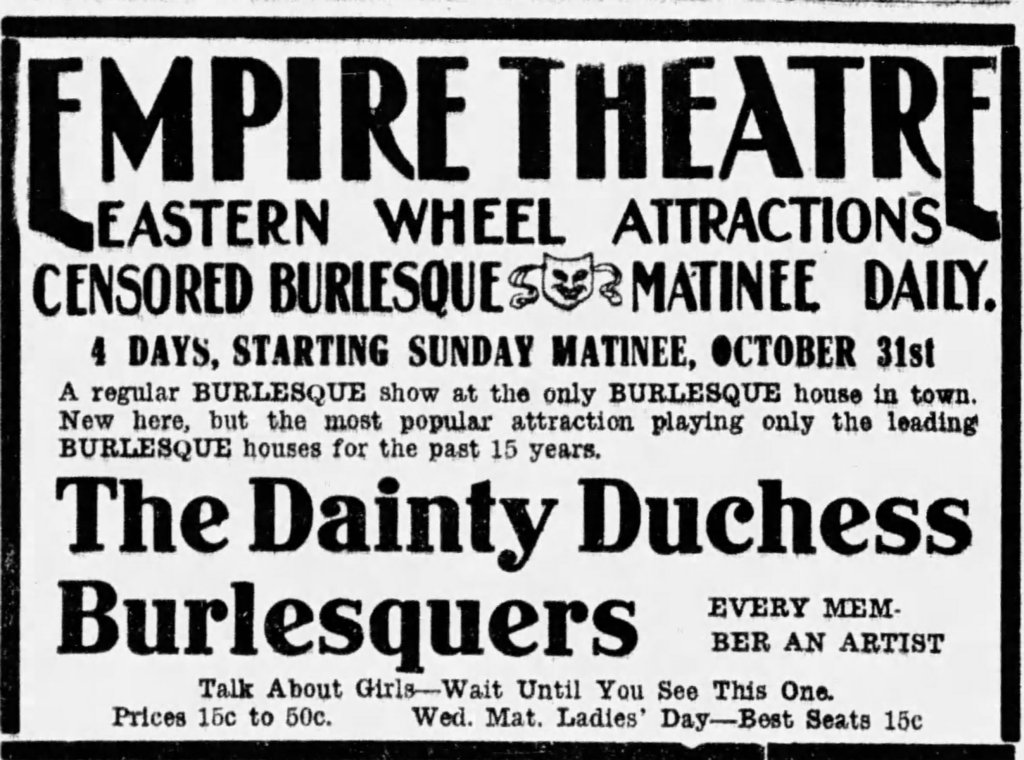
The Empire Theater was a stop on the Western Burlesque Wheel, meaning audiences in Des Moines saw the same shows as those living in Kansas City and Chicago. At its heyday the Western Wheel had 45 companies, averaging 40 people each, on the road at any given night.
The Empire Theater was managed by a man named Ruben. He dropped vaudeville all together to become a burlesque house. He proposed to maintain a high standard, like those in other cities. This was the first time Des Moines had a “steady diet of burlesque.” Once in full swing, the Empire’s new policy was to host amateur burlesque nights on Friday in which locals could aspire for a stage career.
“The Western Wheel has long desired to secure a Des Moines playhouse for their attractions to break the gap between Chicago and Kansas City. The jump which the companies are forced to make between those two cities is long and causes them to miss one performance.” – The Des Moines Register. “Cuts Out Vaudeville.” Page 8. January 1, 1908
Unfortunately, this burlesque house was relatively short lived. By 1910, the Empire theater had its last burlesque performance, “New Century Girls.”
The new manager, M.J. Karger, lamented, ‘Des Moines theatergoers will not stand for denatured burlesque. Des Moines doesn’t want the kind of burlesque that must be presented in a Puritanical town.’ – Des Moines Register. “Burlesque House Closes.” Page 1. February 28, 1910
Krager said his audiences had been drying up. The Empire had been hosting four matinees and four evening performances weekly, but by early 1910, the Empire stopped all burlesque.
The Lyceum Theater
The Lyceum Theater was apart of the “Heuck Circuit” which produced companies of burlesque and vaudeville shows. It was only 50 cents for the night show and 25 cents for the afternoon show. The Lyceum hosted a burlesque show in October 1915. “The Ducklings” were led by a prima donna named Edna Raymond. Edna was interview by the Des Moines Register.
She stated, ‘There is little doubt that burlesque is offering on the best cheap musical entertainments that can be afforded. There was a day when burlesque abounded with girls that couldn’t sing, and musical directors who didn’t know how to teach them. But that’s past…A burlesque show furnishes not less than fifteen song numbers, and often an olio or a series of vaudeville numbers…The objection there has been to the so-called vulgarity in burlesque looks to me like making flesh of the burlesque stage and fowl of the musical comedy and vaudeville stage…No matter how they go out and speak of the vulgarities which the stage is guilty of, they come back next week to get something else to talk about.”
– Des Moines Register. “Want to be Shocked?” Page 28. October 10, 1915
Iowan Actress Sara Blotcky
Sara Blotcky was a Des Moines actress who was reported on in the Des Moines Register in 1908. Sara shocked patrons with her portrayal of Portia in the “Merchant of Venice.”
She quickly burlesqued her lines in the play. She was acting with the Hanford Company at the time. According to the Des Moines Register, Sara had not understudied the character and therefore barely knew the real lines. She decided to burlesque the words she had been given “in a school play a number of years before at the East Des Moines High School.”
Sara had not yet signed as the leading lady of the Hanford Company when she announced she would cease from performing Shakespeare again.
She stated, ‘Next season I expect to go into something entirely different. That is what every actress says and sometimes she does. If I can help it I do not want to go back into Shakespearean roles.” – The Des Moines Register. “Sara Blotcky Wants a Change.” June 1, 1908
1910s-1920s
The Berchel Theatre | Columbia Burlesque Circuit
Beginning in 1919, the Berchel Theatre in Des Moines became a Columbia Burlesque house, hosting traveling shows and companies from the Wheel. However, burlesque revues were being shown at the Berchel as early as February 1917.


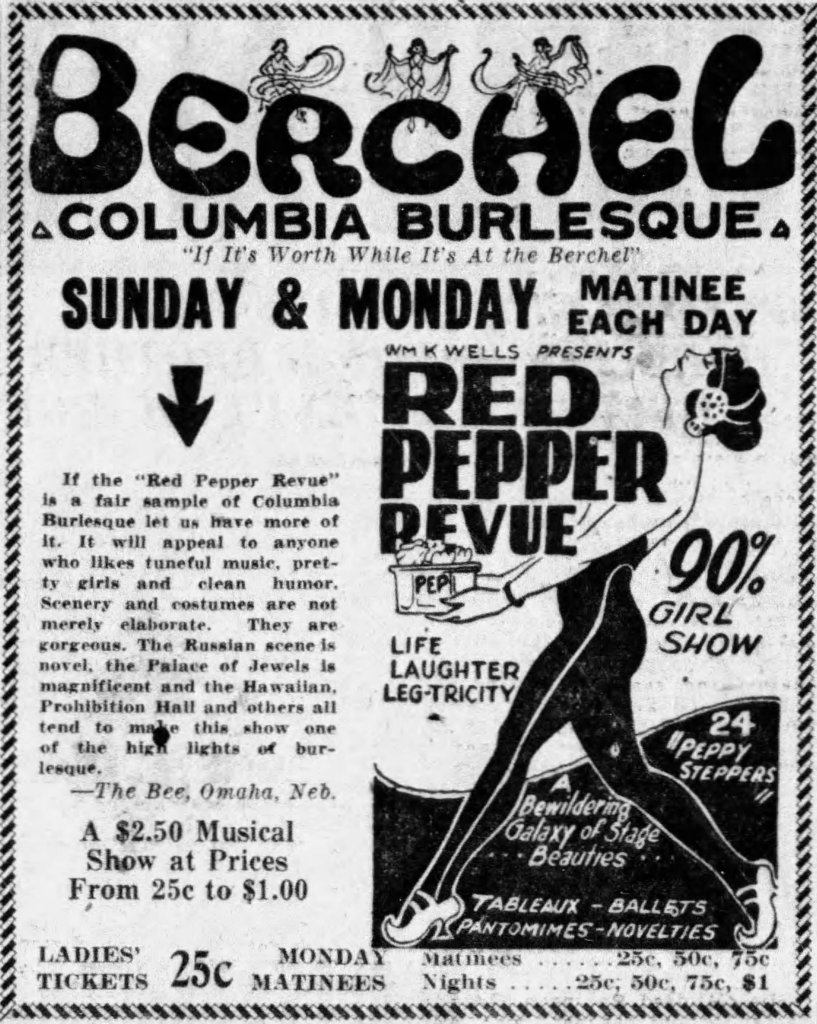
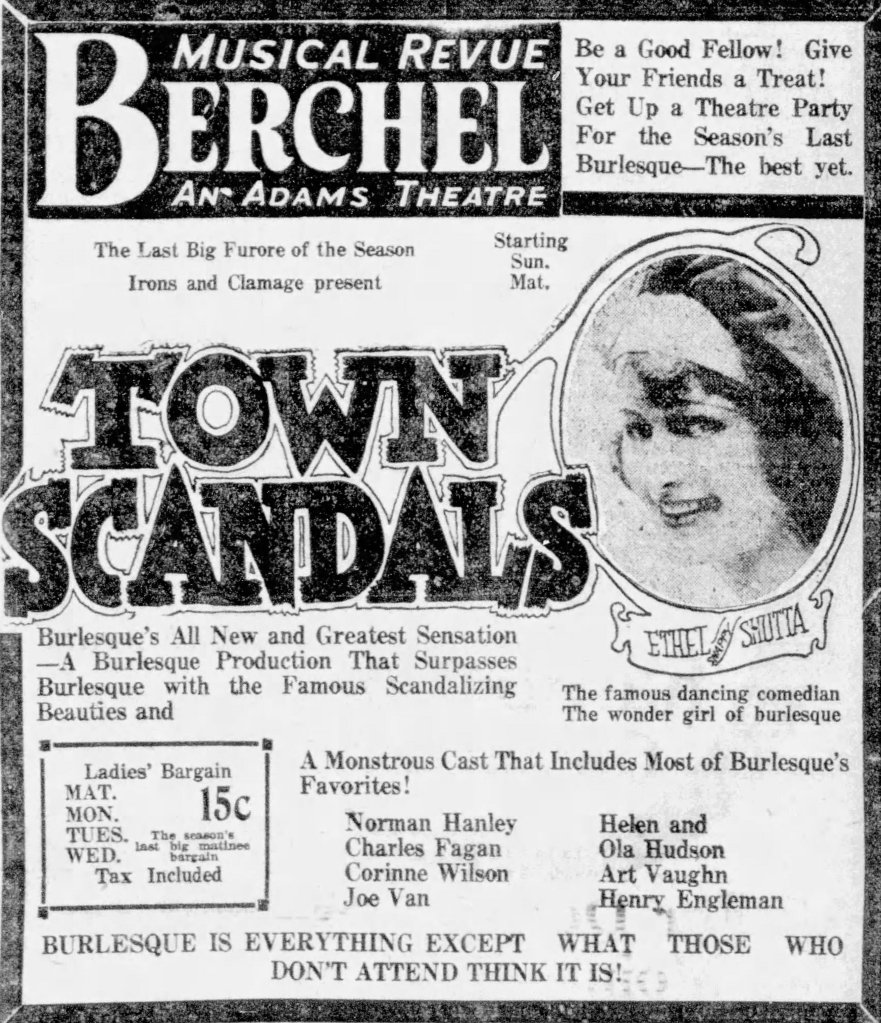

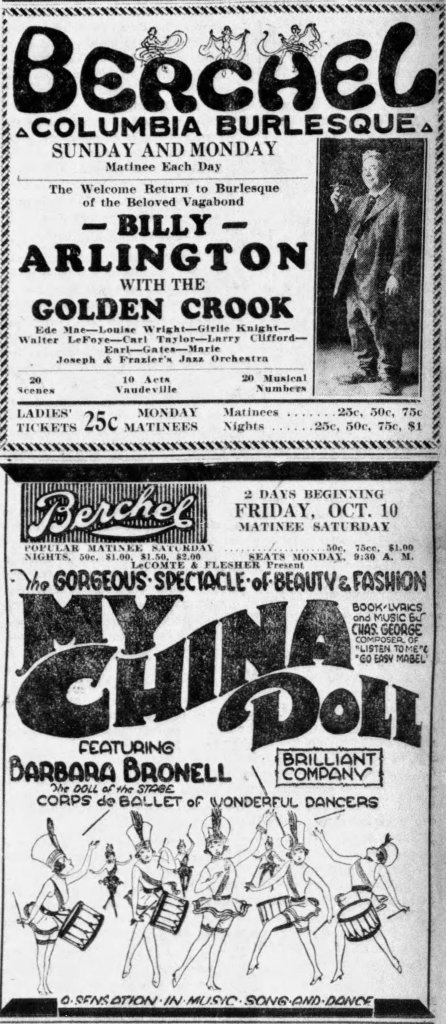
From 1919-1924, patrons in Des Moines were treated to full company burlesque shows at the Berchel and the Garrick Theaters. However, these theaters were not without opposition from conservative community members.

Burlesque had changed in twenty years since coming to Iowa. Burlesque houses all over the country were instituting a stricter system of censorship in order to slip past local authorities. Henry Wieman, the house manager of the Berchel Theater, acted as the local ‘censor’. Every week he would view the first performance of each new burlesque show. He noted anything objectionable that should be removed. Profanity and obscenity were his main concerns. “When Mr. Wieman has finished making the few necessary cuts the musical revue at the Berchel is as healthy and wholesome as can be found.”
The Garrick Theater

The Garrick Theater was originally The Iowa Theater. In 1923, the Iowa hosted Billy Watson’s “Beef Trust” a burlesque show featuring fat women. The Iowa was renamed the Garrick and began showing burlesque regularly in 1924 and 1925. The Garrick was a burlesque house through the Mutual Burlesque Association (another burlesque circuit).


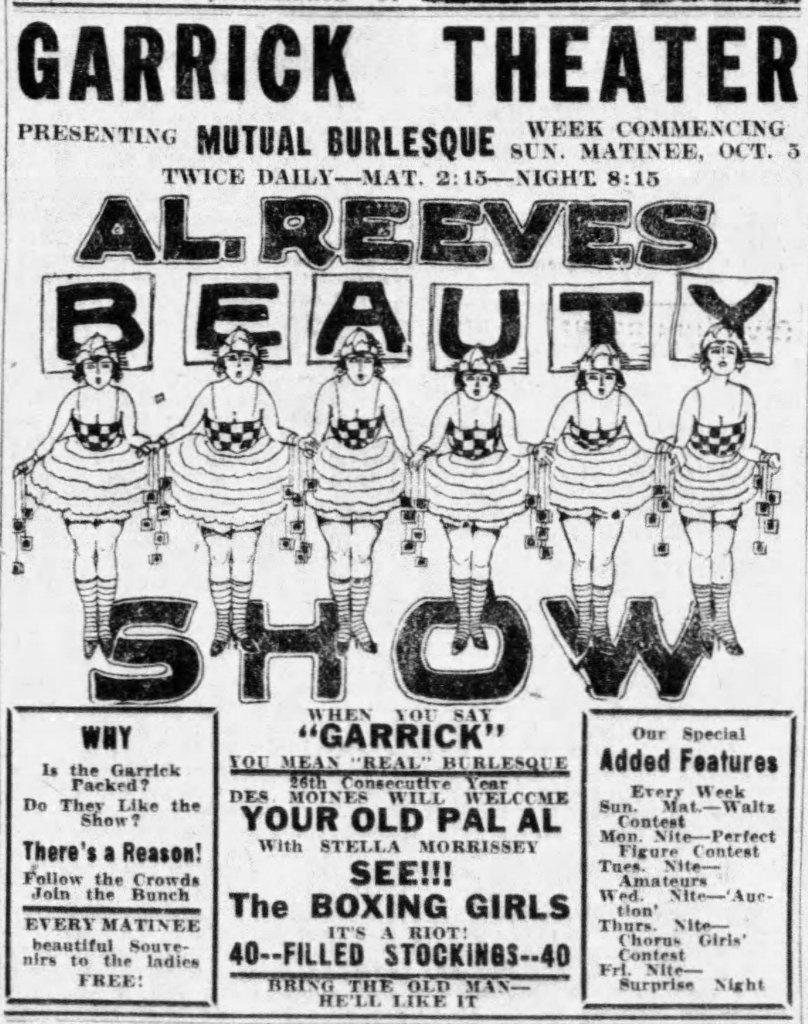
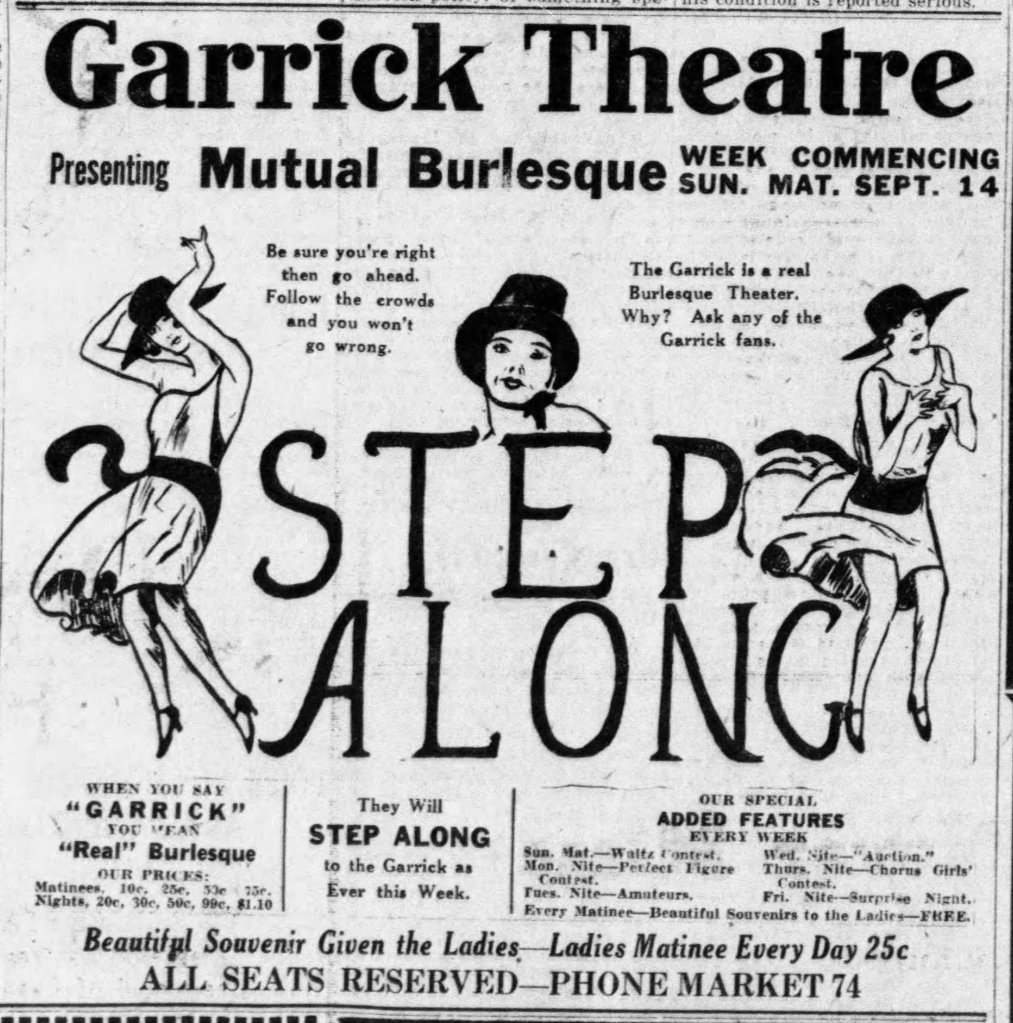


Burlesque continued at the Garrick until the beginning in 1926 when the Garrick’s Manager, N.S. Barger, changed policy, limiting burlesque shows to only showing on Sundays. The rest of the week the house was open to local talent productions and other road show attractions, other than burlesque.
In 1927, the Garrick was renamed the “Mutual-Garrick” as deemed by the Mutual Burlesque association (all Mutual circuit theaters were required to change their names to include ‘Mutual’.) Bernstein’s “Bathing Beauties” opened the 1927 season at the Mutual-Garrick.
In 1928, “Dixon’s Big Revue” played at the Garrick in April 1928. It starred Geraldine McCauley who was billed as “Jerri”. The show carried many players, including a chorus of 16 singing and dancing girls.
After the 1929 stock market crash, the Mutual Burlesque Association went into decline as independent burlesque theaters with local actors and actresses began replacing circuit theaters that only showed traveling companies and shows.
The Mutual-Garrick then became the President Theater. It didn’t show burlesque until 1935 when two groups were interested in using the (at the time) unused President Theater.
George M. Watters | Famous Playwright
The Des Moines boy, George M. Watters, became a sensation when he authored 1927’s most successful play “Broadway” and co-authored an early season success called “Burlesque.” George got his start in 1895 at just 4 years old, he sang and acted in the theater. He began his theatrical career at the Princess Theater in Des Moines. His father was a concert and opera singer, though he died before George was born. George left college at St. Louis University at 17 to become the manager and half owner of a Chicago vaudeville theater. A year later, in 1909, he managed the musical comedy “The Royal Chef”.
He then took a position as a stenographer at the Princess Theater in Des Moines, where he made his stage debut originally. He stayed with theater for 7 years, becoming the press agent, house manager, and director of musical numbers. He wrote several plays during his time there.
He left the Princess to journey to the West coast where he became vice president and general manager of the Newart Picture Corporation, with a studio in Long Beach, California. One of the first films he wrote and directed was “The Naked Truth”. However, he spent two years trying to convince Paramount to show the picture. A few years later, after moving to Dallas, Texas, George sold the film.
In 1920, George created the Capitol Players Stock Company. He expanded to companies in Houston and Birmingham, AL as well. He was fairly successful as the owner and this is where he wrote his first play, “Hot Air.” Reports say he wrote the piece in three days, produced it in five days, and ran it for seven!
In late 1924, George sold the leases, scenery, and good will of his stock. He bought a farmhouse in rural New York and moved his family. He then became the house manager of the Criterion Theater, where he wrote Act 1 of “Burlesque.” Then he became the Central Theater manager and wrote Act 2. It was finished in December 1926 and hit the stage in 1927.
The Majestic Theater
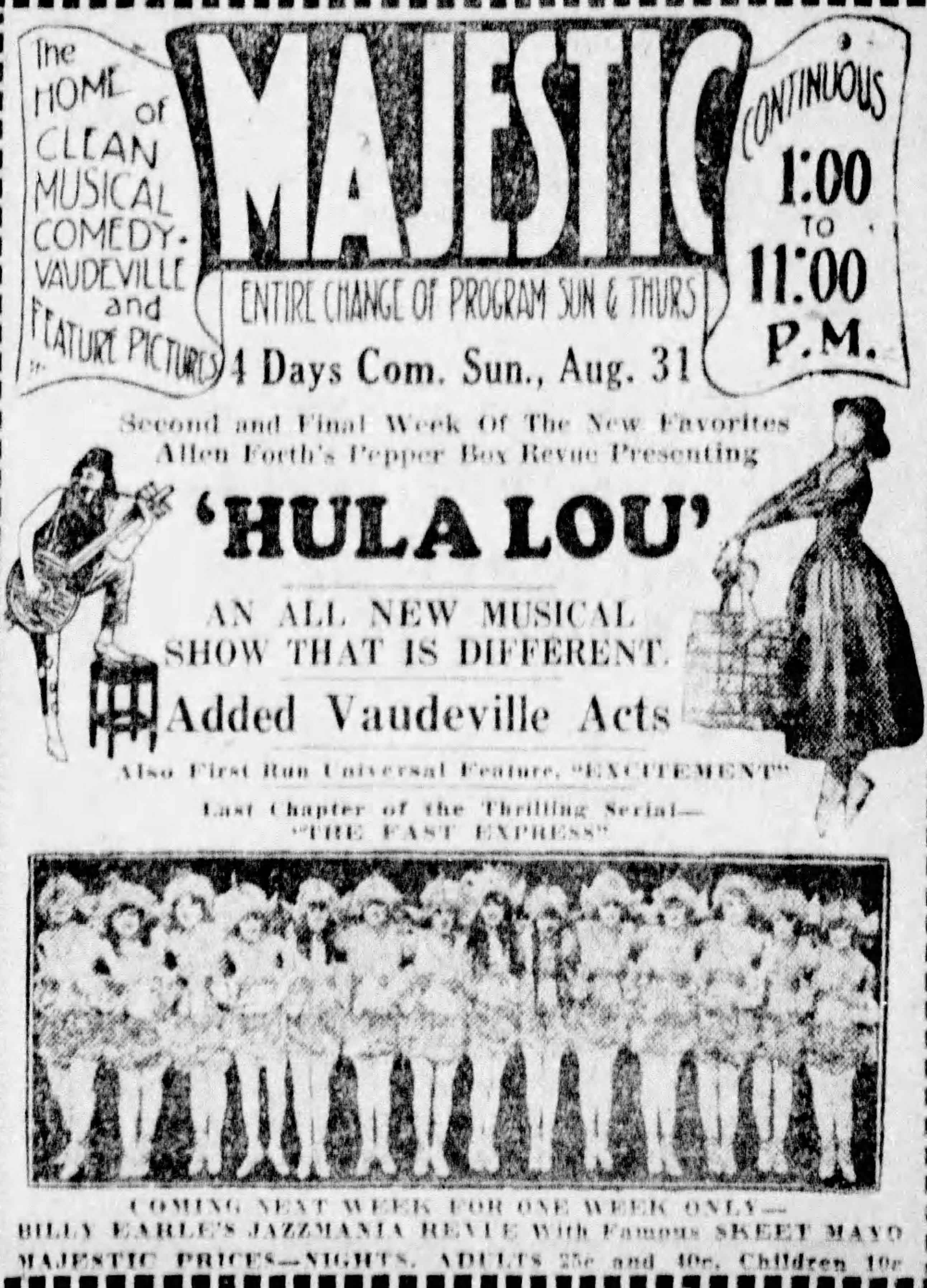

The Majestic Theater was home to “Clean Musical Comedy, Vaudeville and Feature Pictures.” This doesn’t automatically excuse the shows from performing burlesque. Allen Forth’s Pepper Box Revue performed in August 1924 in Des Moines.
1930s-40s
The Casino Show Palace | 1930
The Honeymoon Limited Co. produced a show called “The Male Vampire” that showed at the Casino, “the Show Palace of Des Moines.” The Casino also had midnight burlesque shows at 11:30pm.

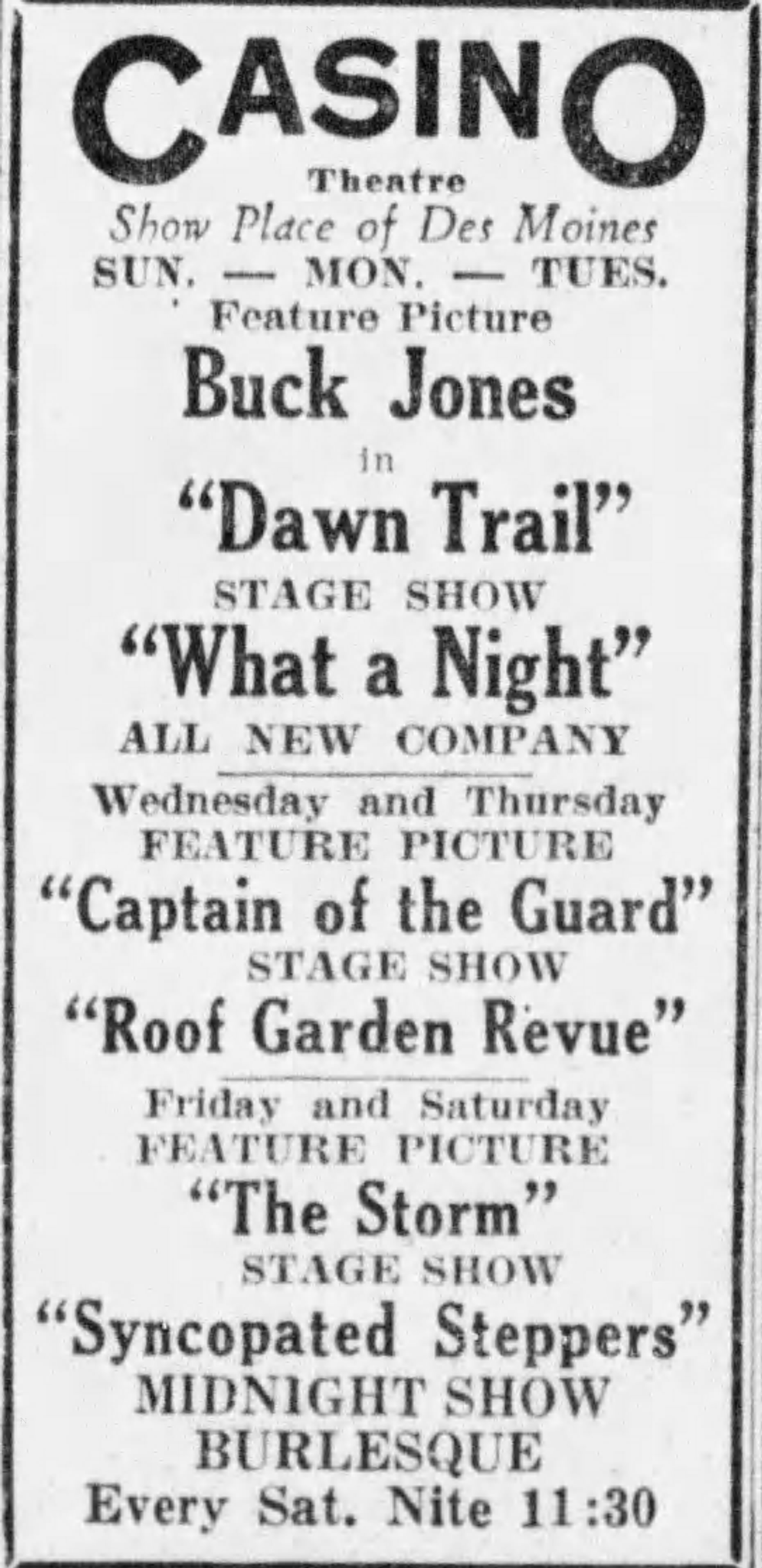

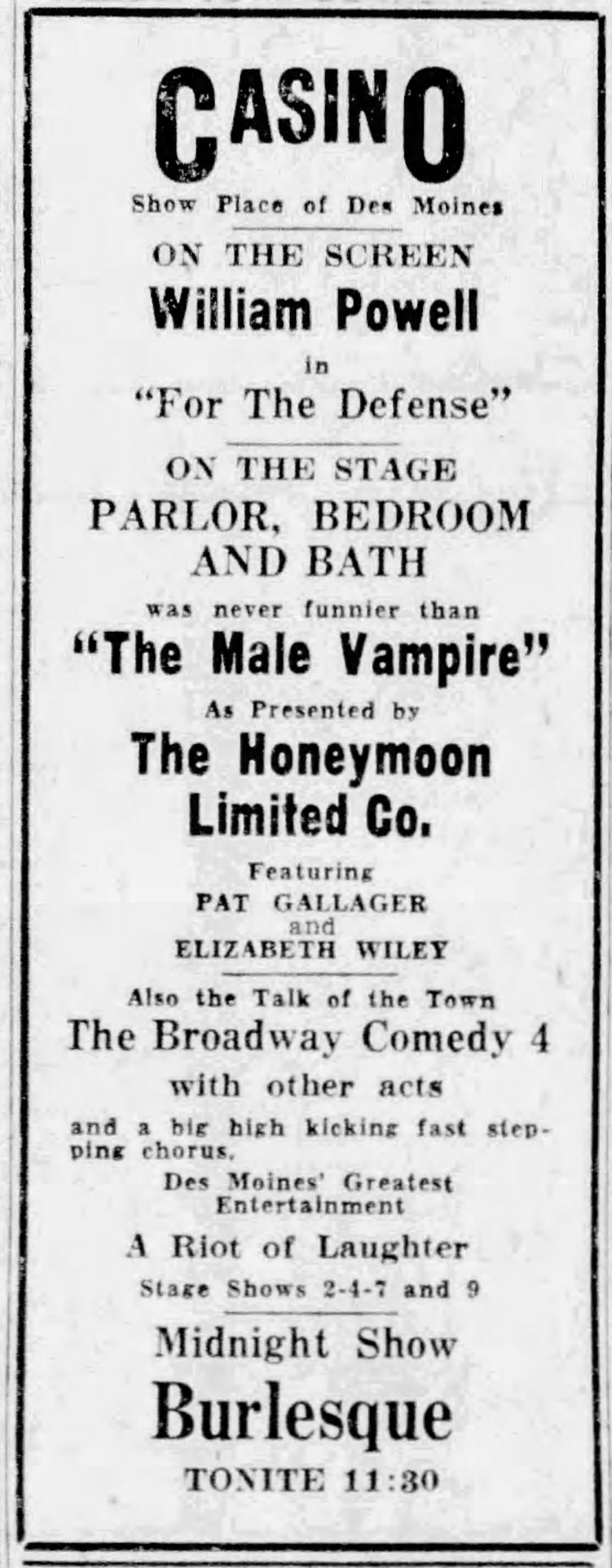
The “Broadway Merrymakers” became the featured entertainers at the Casino theater in 1930. They produced shows such as the “Roof Garden Revue.” Unfortunately, burlesque was short-lived at the Casino. By 1930 burlesque had vanished from Des Moines all together.
Burlesque Dried Up?

Des Moines had no burlesque from 1930-1935, as is evident in the article above, except for the appearance of a burlesque company for one week. In 1935, Abe Frankle, attempted to bring burlesque back to Des Moines. He was unable to negotiate the terms of using the President Theater.
The President Theater
In October 1936, patrons packed the house of the President Theater to witness bawdy and gaudy burlesque! The show was called “Foolin’ Around” and it consisted of the typical burlesque performances of comedians and chorus girls, singers and dancers–including 5 “strip-tease” acts. The stripteasers were greeted with loud shouts and yells. Coins were tossed on the stage. Candy and cigarettes were sold between acts; however, the ushers spread the word it was illegal to smoke in Des Moines theaters. The burlesque dancers were listed- “Boots Burns, a buxom gal, and Dolores DeLeese, a slim but chesty blond.” (Des Moines Register. “Gaudy, Bawdy Burlesque Back.” G.G. October 24, 1936)
A burlesque called “The Cat’s Meow” was produced at the President Theater in November 1937. Jade Rhodora and Coquette provided stripteases at the show.
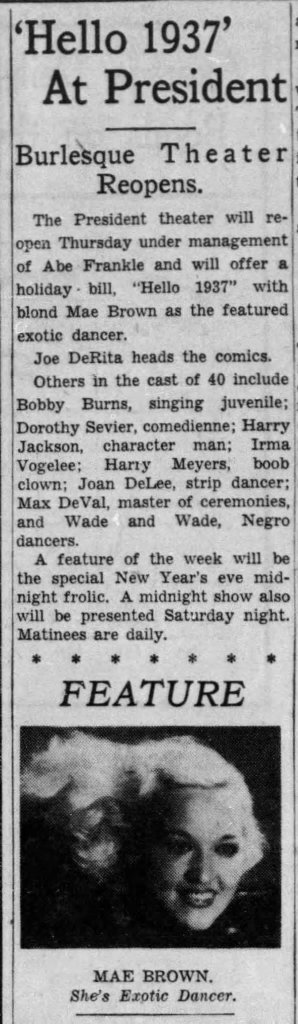
The burlesque show “Hello 1937” featured Mae Brown as an exotic dancer. The cast of 40 included Harry Meyers, “boob clown”, Joan DeLee, “strip dancer”, and Wade and Wade, African American dancers.
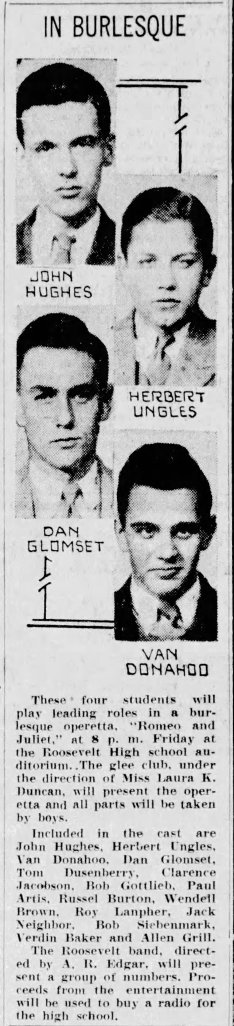
Roosevelt High School produced a burlesque operetta in December 1930. Four male students played leading roles in the burlesque. Proceeds from the show were used to buy a radio for the high school.
The Shrine Auditorium
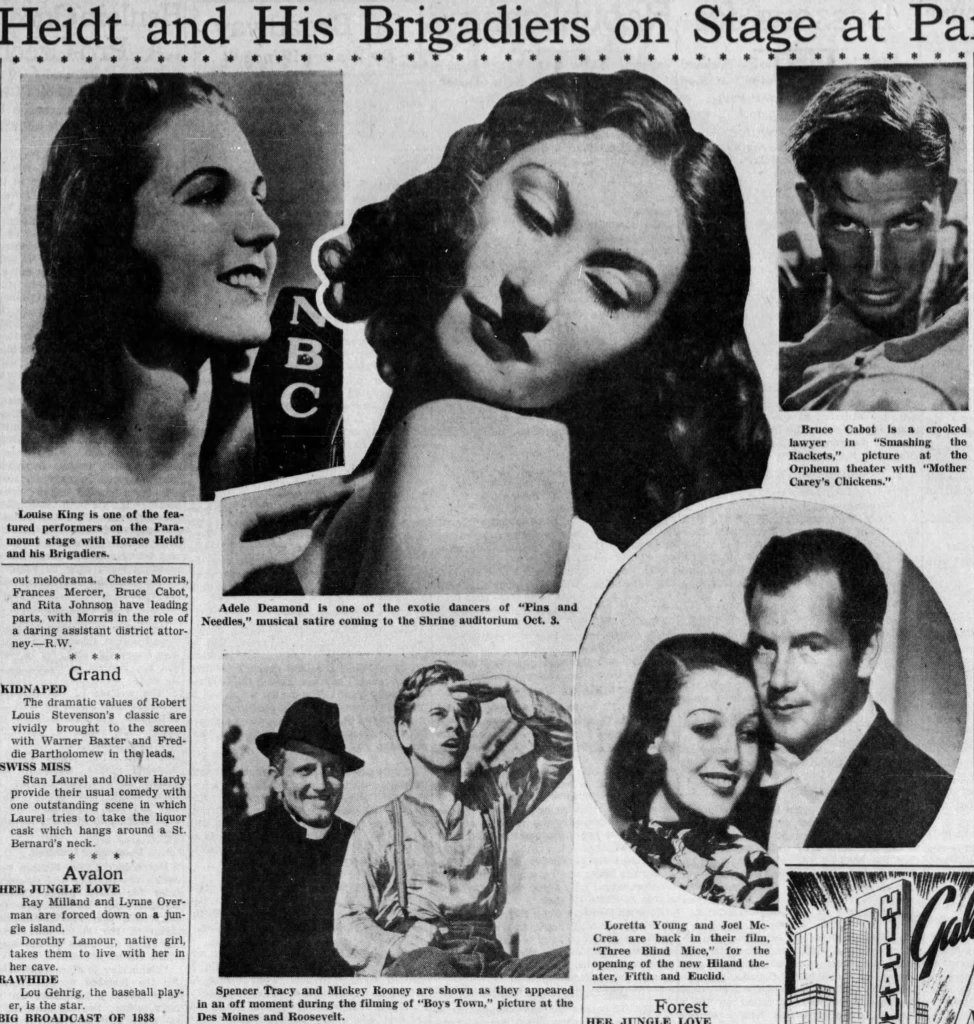
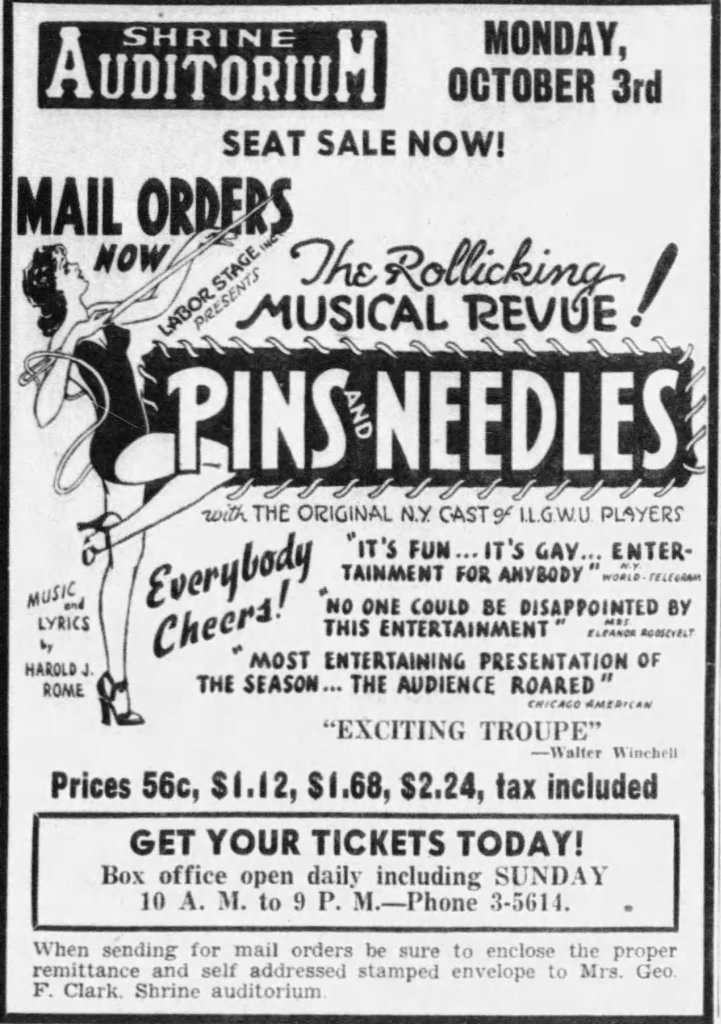
The Shrine Auditorium hosted the show “Pins and Needles” in September 1938. Adele Deamond was an exotic dancer in the musical satire.
Dancer Pleads Guilty | 1936
Louise Stewart, a “burlesque strip-tease dancer” was arrested on a cold Friday in December. She performed a dance consisting of ‘strutting back and forth across the stage while removing her apparel.’ She pleaded guilty to indecent exposure, but only, she said, ‘because it was the easiest way out.’ Her attorney explained to the judge in court that she was the star of the show and was due to open at a new city the next night. The judge fined Louise $25 ($584 in today’s buying power). Louise appeared in court in a large fur coat wrapped around her.
“I’ve been appearing in burlesque five year, and this was the first time anything like this ever happened to me.” – Louise Stewart (Globe Gazette. “Strip Dancer Pleads Guilty.” December 9, 1936)
The police detective testified that he arrested Louise after she removed her bra at the climax of her act, exposing her nipples for “one fleeting glimpse.” Matt Kolb, the Chicago burlesque circuit executive, claimed Louise wore an “invisible brassiere.”
James Allatin, Louise’s manager of the traveling burlesque troupe Louise performed with, paid her $25 fine. Hal Bronson, the theater manager, was also arrested and paid a $500 bond to Polk County. The grand jury waived a state obscenity charge, and he provided a $300 bond for a city charge. The last charge was eventually dropped.
The State Judge dismissed all charges against Louise and Allatin. Shortly after the hearing, Bronson was served with notice to vacate the burlesque theater for non-payment of rent. Bronson was not swayed though and was quoted, “We’ll settle that and continue burlesque in Des Moines.”
Amber D’George & the Casino Follies
Kathryn Gregory, who performed as Amber D’George, was from Fort Worth, Texas. When she was 22 years old, she joined the military as a WAAC auxiliary. In 1942, she left without leave and began performing with a traveling burlesque troupe called “The Casino Follies.” By December, Kathryn perfected her strip-tease act and in December 1942, was discovered by Colonel J.A. Hoag from Fort Des Moines training center.
The Cole Brother’s Circus
In the Summer of 1944, two ‘oriental dancers’ and one ‘female impersonator’ (AKA drag queen) were arrested after performing their side show acts at the Cole Brother’s Circus. The show was closing its two-day engagement in Des Moines and preparing to travel onto Omaha when the head of police and two detectives alleged the dancers were “doing a ‘cooch’ dance of obscene nature in front of juveniles.” Unfortunately, the aftermath of the arrest was not reported on in the newspaper. (Morning World Herald. “Cole Circus Dancers Accused of Obscenity.” Des Moines, IA. July 23, 1944)
To be continued…
From dazzling revues to daring scripts, Des Moines’ early burlesque scene was rich with ambition and artistry. By spotlighting its performers, playwrights, and cultural tensions, we reclaim a vibrant chapter of Iowa’s theatrical past—one that still flickers behind the footlights. Stay tuned for a second article listing burlesque in Des Moines from 1950-2000.
Sources
- The Des Moines Register. Ad for Academy of Music. Page 2. January 26, 1879
- The Des Moines Register. Page 3. June 17, 1879
- The Des Moines Register. “Our Goblins.” Page 3. December 13, 1879
- Des Moines Tribune. Ad for Berchel Theater. Page 6. August 23, 1924
- Des Moines Tribune. Ad for Berchel Theater. Page 2. October 18, 1924
- Des Moines Tribune. Ad for Berchel Theater. April 16, 1921
- Des Moines Tribune. Ad for Berchel Theater. August 30, 1924
- Des Moines Tribune. Ad for Berchel Theater. October 4, 1924
- The Des Moines Register. Ad for Berchel Theater. December 15, 1919
- Des Moines Tribune. “The Spiegel Revue.” Page 7. February 10, 1917
- Des Moines Tribune. “Burlesque=Garrick and Berchel Open with Girl Bills.” Page 13. August 25, 1924
- Des Moines Tribune. Ads for Berchel and Garrick Theaters. Page 3. October 4, 1924
- Des Moines Tribune. “Theaters Have Good Programs.” Page 3. December 6, 1924
- Des Moines Tribune. “Old Favorites on Play Bills.” October 4, 1924
- Des Moines Register. “Carnation Beauties”, “A New Burlesque”. Page 35. September 13, 1914
- Des Moines Register. “The Week at the Playhouses.” Page 24. December 3, 1916
- Des Moines Register. “At the Berchel.” Page 8. December 31, 1917
- Des Moines Register. “Many Musical Revues to Gladden Hearts of Theater Fans.” Page 17. March 31, 1919
- Des Moines Register. “Many of the New Shows To Play Berchel Next Season.” Page 40. June 8, 1919
- Des Moines Register. “Burlesque is Coming Into Its Own with Cleaner and Better Comedy Rewarded by Big Houses.” Joe Jacobs Page 38. December 15, 1919
- Des Moines Register. “Tea for Three is Comedy at Berchel”. Page 56. January 25, 1920
- Des Moines Register. “Two More At Berchel.” Page 31. April 18, 1920
- Des Moines Register. “Burlesque Purges Itself of Baseness of the Past; the Columbia an Example.” Page 22. December 17, 1920
- Des Moines Register. “Henry Wieman Is Board of Censorship Himself; He is Burlesque Show Guardian.” Page 49. January 16, 1921
- Des Moines Register. “Amusement Bills For the Week.” December 15, 1919
- Des Moines Register. “Burlesque’s Early Demise This Season Opens Way for More Better Road Companies.” January 22, 1922
- Des Moines Register. “Abandons Plan for Burlesque.” Page 31. December 29, 1935
- The Falls City Journal. “Missing WAAC In Burlesque Show.” Des Moines, IA. December 4, 1942
- Des Moines Tribune. Ad for Casino Show Palace. Page 7. November 29, 1930
- Des Moines Register. Ad for Casino Show Palace. Page 47. December 14, 1930
- Des Moines Register. Ad for Casino Show Palace. Page 39. December 21, 1930
- Des Moines Register. Ad for Casino Show Palace. Page 35. December 28, 1930
- Morning World Herald. “Cole Circus Dancers Accuse of Obscenity.” July 23, 1944
- Des Moines Tribune. “Empire to Play Burlesque.” Page 3. January 2, 1908
- Des Moines Tribune. Ad for the Empire Theatre. Page 2. October 30, 1909
- Des Moines Register. “Cuts out Vaudeville; Empire Theater will abandon Field Next Week. Becomes Burlesque House.” Page 8. January 1, 1908
- Des Moines Register. “Burlesque House Closes; Empire will have no more burlesque shows.” Page 1. February 28, 1910
- The Des Moines Register. “At the Opera Houses.” Page 16. March 8, 1896
- Des Moines Register. “Performers Piqued; Hanson Tips Hand.” Page 1. December 7, 1909
- Des Moines Tribune. Ad for Garrick Theater. Page 2. October 18, 1924
- Des Moines Tribune. Ad for Garrick Theater. Page 4. September 26, 1925
- Des Moines Tribune. Ad for Garrick Theater. October 4, 1924
- Des Moines Tribune. Ad for Garrick Theater. September 13, 1924
- Des Moines Tribune. Ad for Garrick Theater. September 27, 1924
- Des Moines Register. Ad for Garrick Theater. Page 33. December 7, 1924
- Des Moines Register. Ad for Garrick Theater. Page 49. November 8, 1925
- Des Moines Register. Ad for Garrick Theater. Page 35. November 22, 1925
- Des Moines Register. Ad for Garrick Theater. Page 35. December 6, 1925
- Des Moines Register. Ad for Garrick Theater. Page 33. December 20, 1925
- Des Moines Tribune. “Curtain Up Aug. 23.” Page 9. July 31, 1924
- Des Moines Register. “Theaters have Good Programs.” Page 3. December 6, 1924
- Des Moines Tribune. “At the Garrick.” Page 4. October 31, 1925
- Des Moines Tribune. “Garrick Plays Two Days of Burlesque.” Page 7. December 24, 1927
- Des Moines Tribune. “Mutual Burlesque Plans to Omit Des Moines Next Year.” Wayne M. Weishaar. Page 7. June 23, 1928
- Des Moines Register. “Burlesque Today at the Garrick.” Page 30. October 25, 1925
- Des Moines Register. “At the Garrick.” Page 7. October 26, 1925
- Des Moines Register. “Nita, South American Dancer, Heads Orpheum Bill; Princess Presents ‘Polly Preferred’.” Page 33. November 1, 1925
- Des Moines Register. “Garrick to Put on Road Shows Part of Season.” Page 2. January 17, 1926
- Des Moines Register. “Theater Season Opens; Garrick First to Ring Up; Princess Follows.” Page 44. September 4, 1927
- Des Moines Register. “‘Jerri’ Billed As Garrick Attraction.” Page 50. April 15, 1928
- Des Moines Register. “Burlesque Here Again Possible.” Page 12. December 14, 1935
- Des Moines Register. “Houdini at the Orpheum; Burlesque at the Iowa (Garrick); Comedy at the Princess.” Page 35. January 28, 1923
- Des Moines Register. “Watters Did His First Acting In Des Moines.” Page 18. September 11, 1927
- Des Moines Register. “More Blondes.” Page 4. November 25, 1871
- Des Moines Register. “Chapman Sisters.” Page 4. March 19, 1874
- Des Moines Register. “The Chapmans.” Page 4. March 21, 1874
- Des Moines Register. Ad for Grand Opera House. Page 6. September 26, 1885
- Des Moines Register. “Want to be Shocked?” Page 28. October 10, 1915
- Des Moines Tribune. Ad for Majestic Theater. Page 5. August 23, 1924
- Des Moines Register. Ad for Majestic Theater. Page 62. August 31, 1924
- Des Moines Register. “Lisa Weber Troupe Last Night.” Page 4. April 15, 1871
- Des Moines Register. “Gaudy, Bawdy Burlesque Back.” October 24, 1936
- Des Moines Register. “‘The Cat’s Meow’ New Burlesque; Clean But Sparing Show at the President.” November 27, 1937
- Des Moines Tribune. “‘Hello 1937’ at President; Burlesque Theater Reopens.” Page 16. December 30, 1936
- Des Moines Register. “President.” Page 38. January 10, 1937
- Des Moines Tribune. “In Burlesque.” Page 24. December 5, 1930
- Des Moines Register. “Sara Blotcky Wants a Change.” Page 8. June 1, 1908
- Des Moines Tribune. “Adele Deamond” Shrine Auditorium. Page 3. September 17, 1938
- Des Moines Tribune. Ad for “Pins and Needles” at Shrine Auditorium. Page 3. September 17, 1938
- Omaha Daily Bee. “Iowa Men Well Cared For.” Des Moines, IA. Page 8. October 18, 1898
- Globe Gazette. “Strip Dancer Pleads Guilty.” December 9, 1936

Leave a comment