

“In the early seventies the only travelling opera company of a comic character was that headed by Alice Oakes. She was, in her day, a very clever artist…”
— The Journal, “The Comic Opera,” August 12, 1903, p. 9
Alice Oakes was a soubrette, harpist, and actress who carved out a remarkable career in the late 19th century, touring across the United States and abroad with her troupe, The Oakes Company. Founded and managed by her husband, John H. Oakes, the company blended operetta, burlesque, and novelty acts, becoming a fixture of popular entertainment in the Gilded Age.
Alice was born Alice Frances Lakin on February 23, 1858 in Boston, MA. She was the daughter of John J. Lakin, of Boston, and Florence, of England. She married John Hutchinson Oakes on October 2, 1881 in Plymouth, IA. They went on to have two children (at least) – Hazel and Norman Oakes.
Origins: The Oakes Brothers’ Concert Company

The Oakes Company began with the Oakes Brothers’ Concert Company, formed in 1875. In 1878, the Oakes Brothers’ show included vocal and instrumental music alongside “Dutch and Irish” comic turns and so‑called “negro specialties,” which contemporary evidence indicates were performed by white entertainers in blackface.
Despite their success, the Oakes Brothers faced scandal in December 1878 when accused of failing to pay performers and attempting to evade creditors by shipping baggage out of reach. The Lincoln Journal Star condemned them:
“The only four performers of any note they had in the company, are swindled out of their earnings, simply because their time had expired and they refused longer to remain with men who knew nothing about the show business, and proved, time and again, they were dishonest.”
— Lincoln Journal Star, Dec. 31, 1878, p. 1
Alice Takes the Stage
By 1879, the troupe was rebranded as the Alice Oakes Company, performing burlesque operas such as Pinafore at St. Louis’ Olympic Theater. Alice quickly became the star attraction.
Contemporary accounts praised her artistry:
“Young, accomplished, possessing a good wardrobe and lady-like appearance, she steps at once into the hearts of her audience and becomes a supreme favorite. Mrs. Oakes possesses a contralto voice of remarkable sweetness and purity of tone…She is also a fine dramatic artist…Another feature of her performances are her beautiful and brilliant harp accomplishments.”
— Emporia Daily News, Dec. 6, 1882, p. 4
Alice’s harp — a Gothic Double Action Harp manufactured by Brown and Burrell for $1000 ($34,102.74 in today’s buying power) — was the highly ornate centerpiece of her performances. She sang, played, and even incorporated burlesque sketches, embodying the versatility expected of a soubrette.

“Soubrette” A Definition
A soubrette was a comic female character in opera and theatre, typically portrayed as a lively, flirtatious, and witty young woman. Originating in French comedy and later appearing in opera buffa and operetta, the soubrette was often mischievous, coquettish, and independent in spirit. On stage, she provided comic relief, gossip, and playful banter. Soubrette was used in the early history of American burlesque to describe female burlesquers who would sing, dance, and act in various roles, regardless of the character’s gender.
The Merrie Makers and Bell Ringers
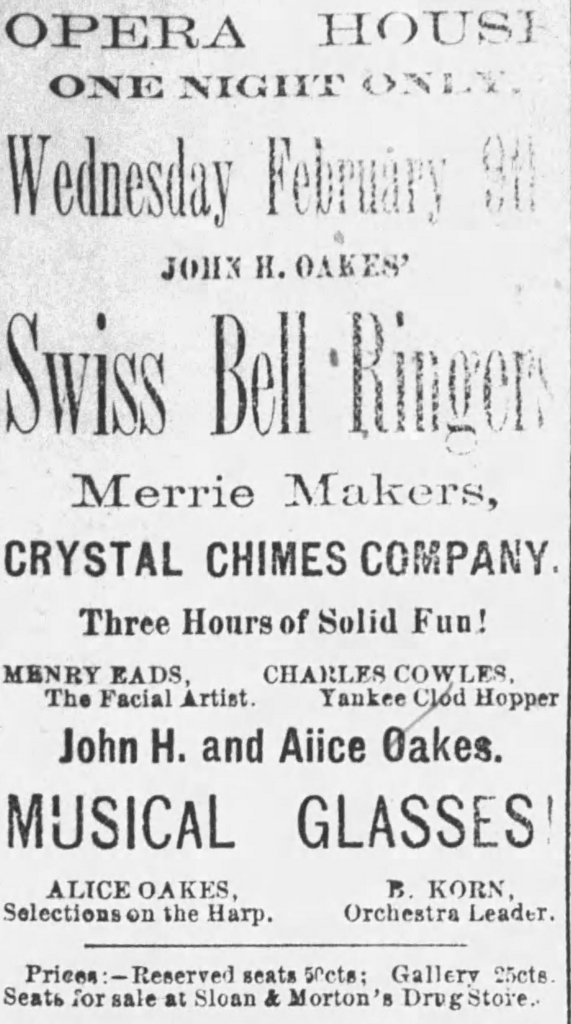
In 1887, John H. Oakes launched a new touring show: The Merrie Makers and Bell Ringers. Alice performed solo numbers and duets with John on musical glasses, earning enthusiastic encores. The troupe also featured eccentric acts: Charles Cowles (a medium), Benjamin Korn (violinist), and Harry Eades (facial contortion artist).

The Lincoln Journal Star reported on their appearance at the Peoples’ Theatre in Nebraska:
“For three hours the audience was royally entertained…A decided hit was made by John and Alice Oakes in their rendition of several selections from Mikado and others of the popular operas, on the bells…The wonderfully sweet tones brought out by them from glasses partly filled with water was duly appreciated.”
— Lincoln Journal Star, Feb. 19, 1887, p. 4
Financial Troubles and Arrests
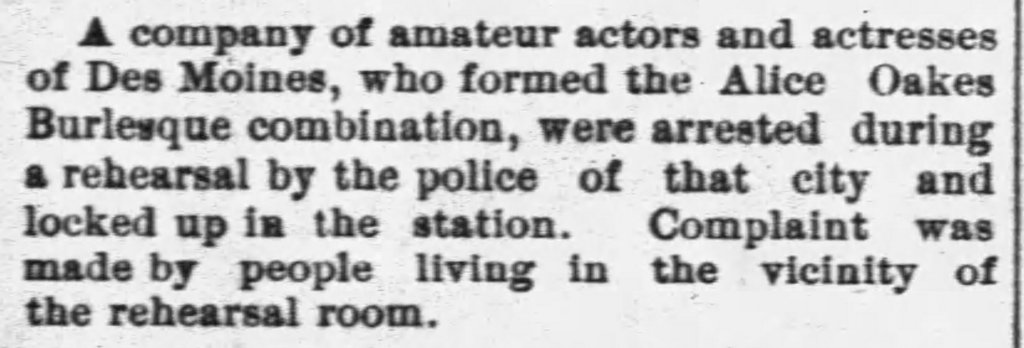
The Oakes Company was not without controversy. In 1882, after a performance of Little Duke in Milwaukee, the sheriff seized company funds, leaving treasurer Fred Hall with a broken rib during the scuffle. Later, in 1888, Alice and John faced arrest in Des Moines.
Reinvention: Comedy Sketch Club and Bell Ringers
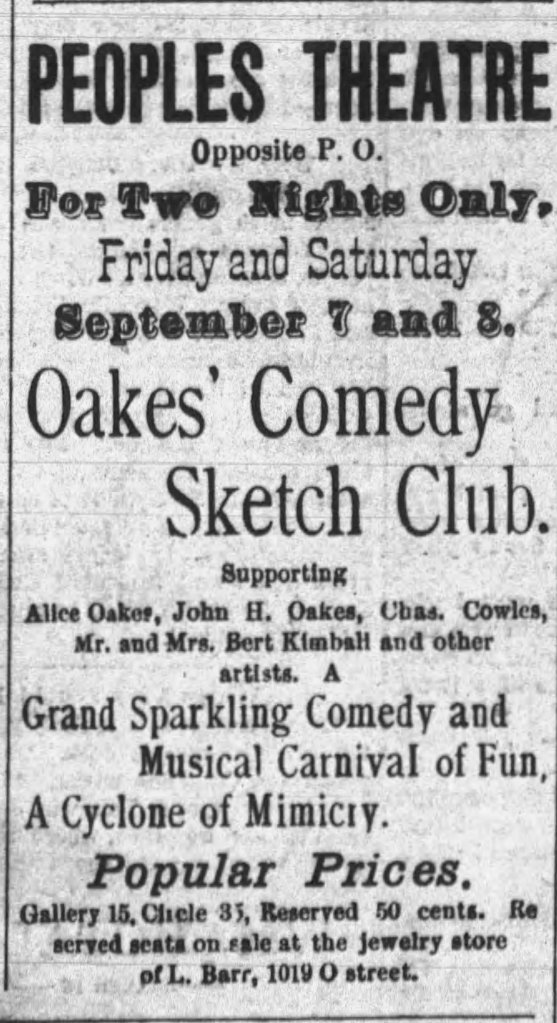
By 1888, the troupe was billed as the Oakes Comedy Sketch Club, featuring ventriloquists Mr. and Mrs. Bert Kimball, comedian Charles Cowles, and Alice as “the world’s harpist.”
From 1891 to 1898, the company toured as Oakes’ Company of Comedians and Swiss Bell Ringers, with Harry Eades’ facial contortions and impersonations as a highlight. Their burlesque Risibles was criticized by St. Louis papers as “too coarse” for the stage, better suited to a beer garden.
Yet audiences continued to adore Alice’s harp solos. The Denver News declared:
“The bell ringers was encored to the echo…but probably the best number of the programme was the harp solo of Alice Oakes. She has a magnificent instrument and knows how to play it.”
— Denver News, July 16, 1892, p. 3
Legacy
Alice Oakes embodied the hybrid artistry of late 19th-century popular entertainment — part operetta, part burlesque, part novelty act. Her harp, voice, and stage presence won her acclaim across the Midwest and beyond, even as the Oakes Company weathered financial scandal and shifting tastes. Hazel Oakes, Alice and John’s daughter, also performed on stage in vaudeville and burlesque.
Alice Oakes lived in McPherson, Kansas according to the 1930 US Census. She died in 1937 at the age of 79. Though remembered today only in scattered newspaper accounts, Alice’s career illustrates the vibrant, precarious world of traveling comic opera companies in America’s Gilded Age.
*If you have any information about Alice Oakes, pre- or post- Oakes Company, please contact Iona Fortune!
Sources
Advertisements
- Brainerd Dispatch. Page 3. January 29, 1886
- Fargo Daily Argus. Page 5. December 18, 1885
- Lincoln Journal Star. Page 4. September 4, 1888
- The Daily Nebraska Press. Page 4. February 9, 1887
- The Joplin Herald. Page 4. November 23, 1882
- The Omaha Herald. Page 8. March 22, 1879
- Wichita Daily Times. Page 4. October 31, 1882
- Lincoln Journal Star. Ad for Oakes Comedy Sketch Club. Page 8. September 7, 1888
Articles
- Brookfield Gazette. “The Oakes Concert.” Page 3. August 19, 1880
- Emporia Daily News. “Alice Keith Oakes.” Page 4. December 6, 1882
- Kansas People. Amusements. Page 4. December 6, 1882
- Omaha Daily Bee. “Maggie Mitchell, Known and Loved Thirty Years Ago for Her Fanchon.” Page 21. March 24, 1918
- The Journal. “The Comic Opera.” Page 9. August 12, 1903
- Sun Journal. “Musical Director Mystic Theatre Dead in Portland.” Page 12. February 8, 1916
- The Gazette. Page 3. December 11, 1888
- The Sentinel. “Attaching a Show.” Page 1. March 17, 1882
- The Sioux City Journal. Page 3. September 14, 1883
- The St. Louis Republic. “Twenty-Five Years Ago To-Day in St. Louis.” Page 10. February 24, 1904
- Jefferson City Tribune. “John H. Oakes’ Bell Ringers.” Page 4. December 15, 1887
- Lincoln Journal Star. “The Merrie Makers at the Peoples.” Page 4. February 19, 1887
- Atchison Champion. “The Oakes Brothers.” Page 4. November 27, 1878
- Blue Valley Blade. Oakes Brothers. Page 5. June 2, 1880
- Green Bay Press Gazette. “Days and Dates to be Remembered.” Page 6. June 17, 1875
- Lincoln Journal Star. “The Oakes Brothers.” Page 4. December 29, 1878
- Lincoln Journal Star. Page 1. December 31, 1878
- McPherson Republican. Page 4. December 20, 1882
- New York Mercury. “Kansas City, MO…Jan. 19.” Page 7. January 25, 1879
- The Waco Daily Examiner. Page 4. September 15, 1878
- Lincoln Journal Star. “Amusements. Peoples Theatre.” Page 4. September 5, 1888
- The Falls City Journal. Page 8. December 7, 1888
- Carroll Sentinel. Page 3. July 16, 1892
- Estherville Daily News. The Oakes Swiss Bell Ringers. Page 5. July 8, 1896
- Iowa Postal Card. Page 8. August 17, 1893
- The Daily San Diegan. “The Bell Ringers.” Page 1. January 14, 1891
- The New York Clipper. “Roster of the Oakes Comedy Sketch Club.” October 20, 1888
Websites

Leave a comment