

Belle Howitt was a celebrated soubrette of the British Blondes troupe. She appeared in productions such as Ixion, Poll and Partner Joe, and Hamlet, often alongside stars like Lydia Thompson, Lisa Weber, and Pauline Markham. These shows were part of the “British Blondes” phenomenon, which introduced risqué humor and bold female performers to American audiences. Little is known about Howitt’s early life, but her documented stage credits reveal a performer in high demand of New York burlesque.

Lydia Thompson and the British Blondes

Lydia Thompson was a trailblazing figure in 19th-century theater, credited with introducing British burlesque to American audiences in a way that transformed popular entertainment. Arriving from England in 1868, Thompson brought her troupe—the “British Blondes”—to New York, where they debuted in Ixion at Wood’s Museum. Their performances were witty parodies of classical works and contemporary culture, blending satire, music, and dance with bold costuming and suggestive humor. This was a radical departure from the genteel norms of Victorian theater, and it sparked both fascination and outrage.
The British Blondes became a cultural phenomenon, drawing packed houses and intense press coverage. They challenged gender expectations by placing women at the center of comedic power, often in roles traditionally reserved for men, and their daring style provoked debates about morality and art.
Belle Howitt’s Signature Roles

Belle Howitt’s career reflects the transformative power of burlesque in American theater. At a time when women were challenging social norms, performers like Howitt carved out spaces for autonomy and artistry. Her encore-worthy songs and dances suggest a performer who understood how to captivate and entertain, leaving audiences clamoring for more.

One of Howitt’s most celebrated roles was Zuleika, a male prince, in a burlesque staged at the Grand Opera House in May 1871. Contemporary reviews praised her charm and versatility:
“Miss Howitt acted Zuleika in a charming manner, her impersonation being arch and spirited. An opportunity was afforded her for the performance of two songs and dances—‘It’s Naughty but It’s Nice,’ and ‘Dew d’Andes’—both of which were so effectively rendered that the audience demanded their repetition. She was costumed with taste.” (New York Clipper, June 3, 1871)
This quote captures the essence of Howitt’s appeal: playful, talented, and stylish, she embodied the burlesque ideal of blending humor with sensuality.
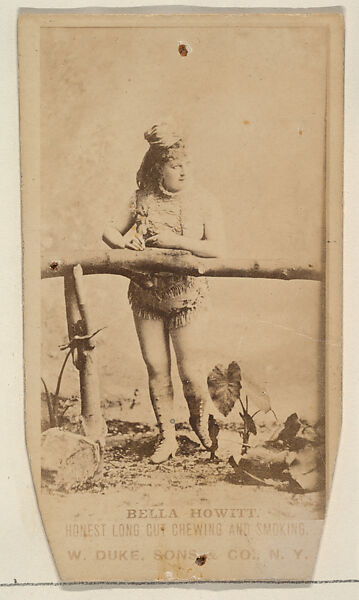
At the end of the nineteenth century, cigarette makers like W. Duke, Sons & Co. used burlesque performers to market their products. Bella Howitt, a burlesque actress, appeared in the company’s Actresses, Celebrities, and Children trade card series, which circulated widely as advertising ephemera. Her image illustrates how tobacco companies borrowed the glamour and notoriety of the stage to lend cigarettes cultural cachet, documenting the intersection of burlesque, consumerism, and visual culture in this period.
Hamlet
Belle Howitt played Ophelia in this musical burlesque at the Olympic Theatre. The cast included stage luminaries such as George L. Fox, Blanche Bradshaw, and other notable burlesque actors. Reviews emphasized Howitt’s comedic musical presence. The New York Clipper noted her energetic rendition of “The Girl with the Golden Switch,” which earned an encore.
The New York Herald praised her playful stage presence:
“Ophelia always turns her back on Laertes and sings to the audience… subsides in a ‘song and walk around’… every male neck strained to catch a glimpse of the fair Ophelia’s feet.” (February 15, 1870)
A cheeky review highlighting the risqué humor that made burlesque so controversial and popular.
Ixion or, The Man at the Wheel
In the 1870 revival at Wood’s Museum, Howitt starred in this mythology-themed burlesque by F. C. Burnand. In a 1872 version she headlined the extravaganza. A review from New York Herald (April 30, 1872) stated:
“Miss Belle Howitt imparted much humor to the title role and sang and danced with her accustomed grace and spirit.”
The New York Clipper (May 11, 1872) added that two new numbers—“A Nobby Sport am I” and “Dolly Varden”—featured Howitt, with audiences enjoying her performance.
Lurine
A BroadwayWorld cast listing confirms Howitt starred alongside Pauline Markham in this lavish burlesque adaptation of Heinrich Heine’s legend. Though specific reviews were scarce, the production likely mixed parody, dance, and song in keeping with burlesque conventions of the era.
Poll and Partner Joe
This original musical burlesque premiered at Daly’s Theatre (AKA Wood’s Museum), featuring Howitt as a leading performer. It ran for 10 performances. Written by F. C. Burnand with music arranged by Napier Lothian. It was produced by Mrs. John Wood.
Chow Chow or, A Tale of Pekin
This musical burlesque extravaganza—book by James Barnes, music arranged by William Brinkworth—opened at Wood’s Museum with Belle Howitt listed among the ensemble cast with Lisa Weber and Pauline Markham. It played for 24 performances during its run. It was billed as a lavish spectacle with exotic Chinese-themed settings, parodying Orientalist tropes popular in Victorian entertainment. University of Florida’s Belknap Playbills Collection includes a program confirming her role in the piece.
While full reviews are rare, contemporary commentary suggests the show leaned heavily on visual spectacle and comedic songs. Howitt’s inclusion in the cast indicates she likely performed musical numbers and comic dances similar to her work in Ixion and Poll and Partner Joe.
From Actress to Producer
By 1879, Belle Howitt had taken a bold step that set her apart from many of her contemporaries: she founded the Belle Howitt Burlesque Company (also billed as the Belle Howitt New York Burlesque Combination). This move marked her transition from celebrated performer to theatrical entrepreneur, signaling not only her ambition but also her understanding of burlesque as a business. At a time when most theatrical management was dominated by men, Howitt’s leadership placed her among a pioneering group of women who asserted creative and financial control over their careers.
Women-led burlesque troupes were a growing phenomenon in the late 1870s and 1880s, following the trail blazed by Lydia Thompson and her British Blondes. These companies capitalized on the popularity of burlesque’s cheeky humor and spectacular staging, while also navigating the era’s moral controversies. Female managers like Howitt faced unique challenges: they had to maintain the allure and daring that audiences craved while contending with critics who accused burlesque of impropriety. Running a troupe required negotiating contracts, booking tours, and managing performers—tasks that demanded resilience and business acumen.
The Belle Howitt Burlesque Company toured regional theaters, bringing the British Blondes’ signature mix of parody, music, and dance to audiences beyond New York. This expansion helped sustain burlesque’s popularity into the 1880s, even as tastes shifted toward vaudeville and variety shows.
Burlesque Fame and Scandal
Belle Howitt’s career wasn’t without controversy. A newspaper report from 1880 reveals that she was engaged at the St. Louis Theatre Comique for $75 a week ($2,382.18/week in today’s buying power)—a substantial sum at the time—with strict contractual terms .

She was expected to perform daily, including holidays, and “abstain from all intoxication, vulgarity, and offensive conduct, observing strictly the rules and regulations of the house.” These conditions reflected the tension between burlesque’s risqué reputation and theater managers’ attempts to maintain decorum.
However, the arrangement ended dramatically. The managers sued Howitt for $5,000 in damages, alleging she was “guilty of disorderly and riotous conduct, rendering her totally unfit to perform her part, and injuring the credit and reputation of the establishment by her shameful conduct.” This episode underscores the precarious position of burlesque performers—celebrated for their boldness on stage yet scrutinized offstage for behavior deemed improper.
Impact & Legacy

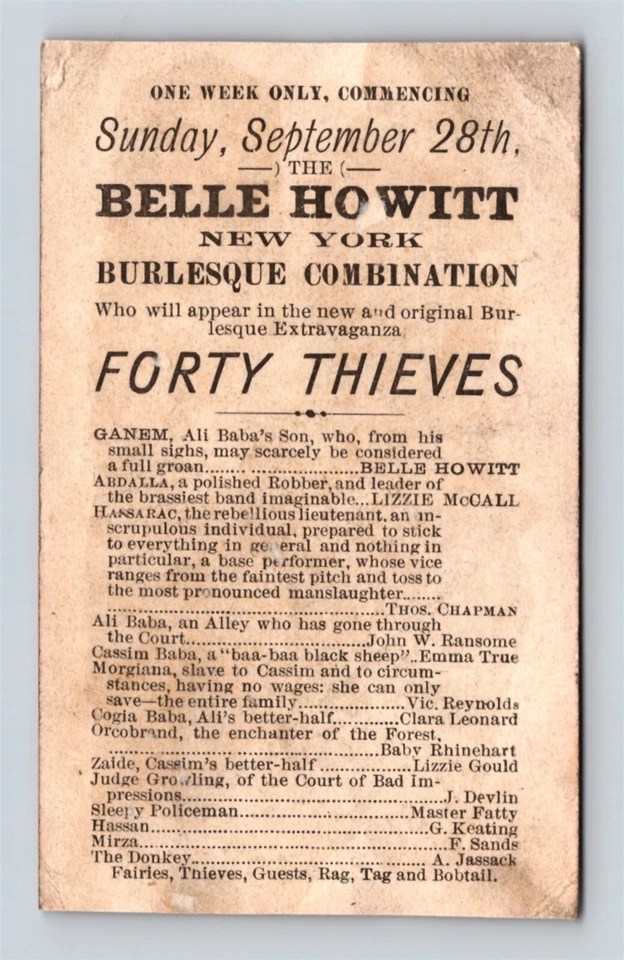
Belle Howitt’s legacy in burlesque history is tied closely to the rise of Lydia Thompson’s “British Blondes,” a troupe that revolutionized American theater in the late 1860s and early 1870s. These performers introduced a daring blend of parody, music, and spectacle that challenged Victorian norms and captivated audiences with their wit and boldness. Howitt, often billed alongside stars like Lisa Weber and Pauline Markham, embodied this new theatrical spirit—bringing humor, elegance, and a touch of scandal to the stage.
Her creation of her own troupe underscores her lasting impact: she was not only a star of the stage but also a woman who claimed authority in an industry that often sought to limit women’s agency. Her story reflects a broader pattern of women in burlesque transforming performance into a platform for independence and influence.
Though her name faded from popular memory, Howitt’s work helped cement burlesque as a legitimate and influential art form, paving the way for modern musical comedy and the enduring appeal of theatrical satire.
Sources
Websites:
- Belle Howitt – Broadway Cast & Staff | IBDB
- Belle Howitt (Actor): Credits, Bio, News & More | Broadway World
- Belle Howitt – Music in Gotham
- 1870 04 Hamlet (a burlesque) A History of the NY Stage May Blossom .jpg
Newspapers:
- Muscatine Daily Journal. “Belle Howitt.” Page 3. February 5, 1880

Leave a comment