

Burlesque in Cedar Rapids has a rich and surprising history, spanning more than a century of cultural change. From the ornate stage of Greene’s Opera House in the 1890s—where comic burlesques and musical parodies entertained Victorian audiences—to the nightclub revues and exotic dancers of the mid-20th century, the city mirrored national trends in popular entertainment. Traveling carnivals, hotel lounges, and supper clubs kept the art form alive through the Depression, wartime, and the sexual revolution, adapting from theatrical satire to intimate floor shows. By the late 20th century and into the 2000s, burlesque reemerged as a celebrated performance art, blending nostalgia with modern creativity. This evolution tells a story not only of changing tastes but of Cedar Rapids’ enduring appetite for spectacle, humor, and glamour.
1890s-1920s

The 1890s marked the beginning of Cedar Rapids’ flirtation with burlesque, a time when theatrical ambition and entrepreneurial spirit converged on the local stage. Evidence of this growing interest appears in a December 13, 1890 Gazette advertisement seeking a partner to launch a burlesque company—an extraordinary glimpse into the city’s entertainment aspirations. This was an era when burlesque was evolving from Victorian parody into a vibrant mix of comedy, music, and spectacle, and Cedar Rapids was eager to join the trend. The ad reflects not only the popularity of burlesque nationwide but also the confidence that a thriving market for variety entertainment existed in Iowa’s cultural hub.
Greene’s Opera House

For decades, Greene’s Opera House hosted two to three shows weekly, featuring top actors and productions. Notable performers included Edwin Booth, Marie Dressler, Lillian Russell, Will Rogers, Al Jolson, and Cedar Rapids’ own Cherry Sisters. About 20 percent of its shows were musicals. By 1904, the theater boasted modern amenities such as steam-heated dressing rooms, electric lighting, and even electric curling irons for actresses.
After 1910, the rise of motion pictures and competition from larger city theaters led to a decline in opera house popularity. Greene’s closed abruptly in December 1921, leaving scheduled events stranded. The building was remodeled into a cinema at a cost of $35,000, but the venture failed. In 1934, it was converted into a parking garage for the Roosevelt Hotel.
By the late 1960s, the aging structure had deteriorated, developing a large crack in its back wall. Urban renewal plans called for its demolition, and on March 22, 1969, workers began tearing down what The Gazette called “the grandfather of Cedar Rapids theaters
1930s
Paramount Theatre and the Rise of Revue Entertainment
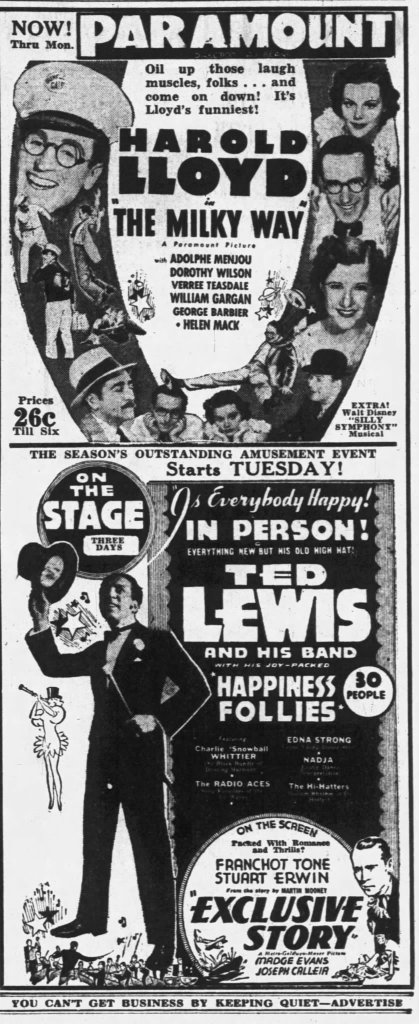
When the Paramount Theatre opened in Cedar Rapids in 1928, it was celebrated as a modern movie palace, but its stage also hosted live performances that reflected the era’s fascination with glamour and spectacle. During the 1930s, the Paramount featured touring musical revues and variety shows that often incorporated elements of burlesque—chorus lines, comedic sketches, and novelty acts—alongside big-band music. These productions blurred the line between traditional vaudeville and burlesque, offering audiences a mix of sophistication and playful risqué humor.
Ted Lewis and the “Happiness Follies”
One of the most notable entertainers of the period was Ted Lewis, a charismatic bandleader whose “Happiness Follies” toured nationally during the Jazz Age and into the Depression years. Lewis’s shows combined his signature jazz orchestra with lavish costumes, comedic interludes, and glamorous dancers, echoing the burlesque tradition of blending music, satire, and sensuality. Lewis’s popularity and the Paramount’s reputation for hosting major acts suggest that local audiences were exposed to similar revue-style spectacles during the 1930s.
Burlesque’s Evolution in the Midwest
By the 1930s, burlesque had shifted away from its Victorian roots and embraced the aesthetics of the modern revue. In Cedar Rapids, this meant fewer bawdy comic sketches and more polished productions featuring chorus girls, exotic-themed dances, and jazz-infused musical numbers. These shows catered to changing tastes during the Depression, offering escapism and glamour at a time when economic hardship dominated daily life. The Paramount Theatre became a focal point for this transformation, bridging the gap between old vaudeville traditions and the emerging world of cinematic entertainment.
Thornwood Garden & Ballroom

In 1937, the Thornwood Garden & Ballroom in Cedar Rapids advertised a floor show featuring an exotic dancer billed as Sheba, a name evoking the era’s fascination with “Oriental” and exotic themes. Such performances were common in Midwest nightlife during the interwar years, blending burlesque traditions with cabaret-style entertainment. These acts often appeared alongside orchestras and chorus lines, offering audiences a mix of glamour, novelty, and escapism during the hardships of the Great Depression. The inclusion of Sheba in local advertising reflects how Cedar Rapids participated in national trends that romanticized foreign cultures and sensual dance as part of the broader evolution of American popular entertainment.
1940s
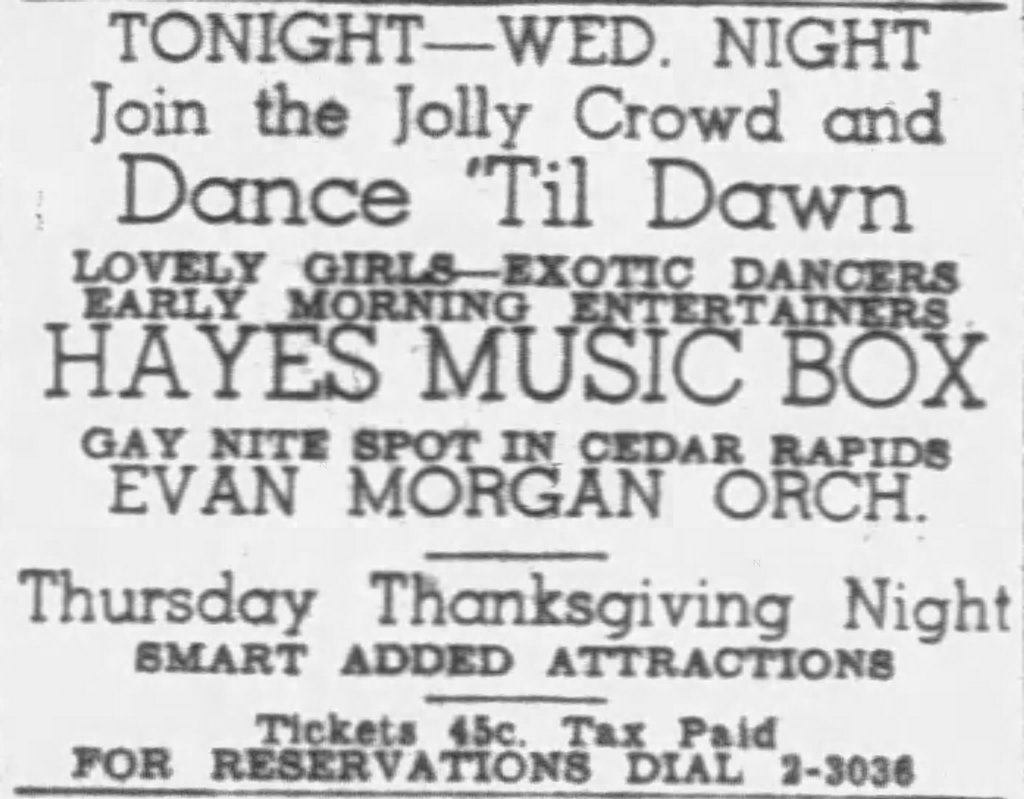
By the 1940s, burlesque had largely shifted from grand opera houses and large theaters to more intimate venues such as nightclubs, ballrooms, and roadhouses. This transition reflected changing entertainment trends and economic realities during and after the Great Depression. Smaller stages allowed for streamlined productions—floor shows featuring exotic dancers, chorus lines, comedians, and live bands—rather than the elaborate sets and large casts of earlier burlesque spectacles. These performances often emphasized glamour and novelty, catering to patrons seeking escapism during wartime. In Cedar Rapids, venues like the Hayes Music Box and Thornwood Garden embraced this format, advertising “exotic dancers” and themed revues that blended sensuality with jazz-age sophistication. This evolution marked burlesque’s transformation from theatrical satire into nightclub entertainment, paving the way for mid-century cabaret culture.
Memorial Coliseum | 1948
On November 30, 1948, the Cedar Rapids Gazette announced a major live event at the Memorial Coliseum: Tito Guízar and his Singing Mariachis. Marketed as “The Singing Idol of All the Americas,” Guízar was a celebrated Mexican vocalist and film star whose popularity bridged Latin American music and Hollywood glamour. The show promised an evening of vibrant entertainment, featuring not only Guízar’s mariachi ensemble but also specialty acts designed to captivate audiences.

Among the featured performers were Carla and Fernando, billed as “exotic dancers direct from Mexico,” highlighting the era’s fascination with Latin-themed spectacle and sensuality. Their inclusion reflects how postwar American entertainment embraced cultural novelty and theatrical flair, often framing international performers as exotic to attract audiences. The program also listed Vincent De Sola, an accomplished concert pianist, alongside “other sensational artists,” suggesting a variety-style format blending music, dance, and visual spectacle. With ticket prices ranging from $1 to $2, this one-night-only event offered Cedar Rapids residents a rare opportunity to experience a cosmopolitan revue on a local stage.
1950s
In the years following World War II, American attitudes toward burlesque and striptease reflected a complex mix of fascination and moral conservatism. While urban nightclubs embraced increasingly risqué performances as part of sophisticated floor shows, smaller cities and rural communities often viewed such acts as indecent or criminal. This tension was fueled by postwar cultural shifts: the rise of consumer leisure, the influence of Hollywood glamour, and the growing popularity of pin-up imagery clashed with traditional values rooted in modesty and propriety. Local authorities frequently enforced strict decency laws, framing striptease as “immoral entertainment,” even as audiences sought novelty and escapism in an era of economic prosperity and social change. These conflicting attitudes highlight how burlesque evolved from theatrical satire into a contested symbol of modernity and sexual expression in mid-century America.
Foresters of America Club Stag Party | October 20, 1955
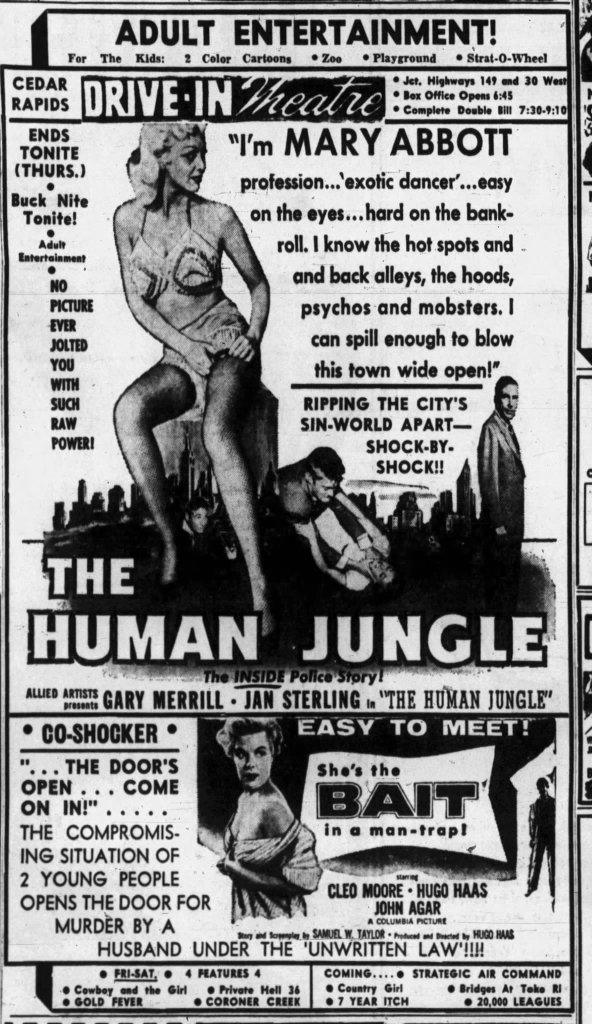
In October 1955, Cedar Rapids made headlines when a Chicago striptease performer was arrested during a Foresters of America Club stag party. The dancer pleaded guilty to charges of “immoral entertainment” after police discovered her performing in only a G-string and mesh hose before an audience of more than 150 men. She was fined $200 and given a three-month suspended jail sentence in Linn County.

The club manager faced separate charges and was released on federal and state bonds totaling $2,500. This incident illustrates the tension between evolving adult entertainment trends and local morality laws in mid-century America. While burlesque and striptease were gaining popularity in urban nightclubs, smaller cities like Cedar Rapids often enforced strict decency standards, framing such performances as criminal rather than theatrical.
Hawkeye Downs Theater
By the late 1950s, traditional burlesque theaters had largely disappeared, but the spirit of burlesque lived on through traveling musical revues and carnival-style shows that toured regional fairgrounds and civic venues. These productions blended exotic dance with mainstream entertainment, presenting audiences with a mix of glamour, comedy, and spectacle. Shows like Mitzi, staged at Hawkeye Downs in Cedar Rapids, were emblematic of this trend. Marketed as “magic avenues of thrills and laughter,” they featured star performers alongside large supporting casts of singers, dancers, and comedians—often numbering in the dozens. This scale gave the impression of Broadway-style sophistication while retaining the sensual allure associated with burlesque.

Traveling revues appealed to mid-century audiences seeking novelty and escapism during a period of cultural transition. They capitalized on the popularity of pin-up aesthetics and Hollywood glamour, framing exotic dancers as headliners within family-friendly variety shows. Unlike the risqué nightclub acts of the 1940s, these revues were packaged as legitimate entertainment, allowing them to thrive at fairs and civic events across the Midwest. In Cedar Rapids, their presence at venues like Hawkeye Downs illustrates how burlesque adapted to survive—shifting from urban theaters to itinerant stages while maintaining its core elements of music, dance, and spectacle.
1960s
The Driftwood Lounge at the Montrose Hotel & Motor Inn
This advertisement from 1968 for the Driftwood Lounge at the Montrose Hotel in Cedar Rapids reflects the evolving striptease and nightclub culture of the 1960s. The ad promotes the Vince Garrett Revue, described as an “exciting show group” offering comedy, dance music, and show tunes—typical of mid-century lounge entertainment that blended variety acts with musical performance. Below, it highlights Zsi-Zsi, billed as an “exotic dancer,” appearing for a limited engagement. The language emphasizes exclusivity (“Tonight and Saturday Only”) and positions the venue as a “FUN SPOT,” signaling how striptease was marketed as sophisticated nightlife rather than fringe entertainment.
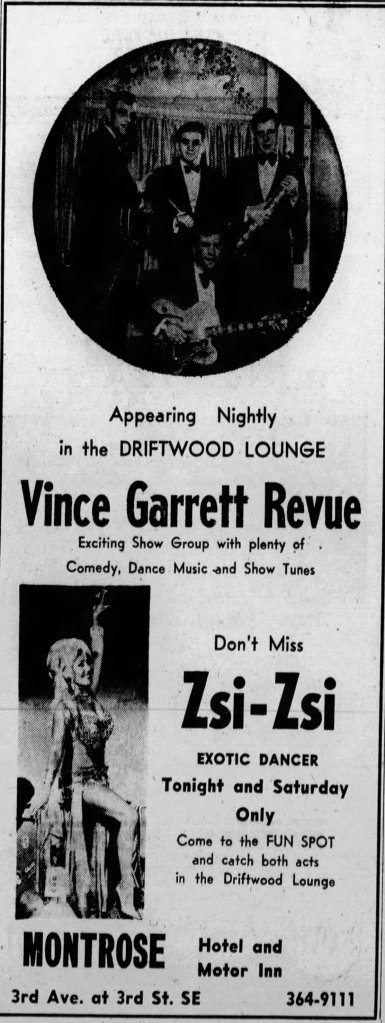
By the 1960s, striptease had shifted from burlesque theaters to hotel lounges and cocktail bars, aligning with the era’s leisure culture and the rise of adult entertainment in mainstream social spaces. These performances were often framed as glamorous and cosmopolitan, appealing to patrons seeking novelty and sensuality in a more intimate setting. Unlike earlier burlesque, which relied on satire and theatricality, 1960s striptease emphasized allure and spectacle, often paired with live music revues to create a full evening experience. This ad illustrates how Cedar Rapids participated in national trends, where exotic dance became a staple of lounge entertainment during a decade marked by loosening social norms and the commercialization of sexual expression.
300 Steak Lounge
This advertisement from August 1967 promotes Ricki Covette, billed as a “6’8” exotic dancer,” appearing for a two-week engagement at the 300 Steak Lounge inside the Cedar Rapids Bowl. The ad emphasizes her extraordinary height as a unique draw, reflecting how mid-century striptease culture often marketed performers through sensational attributes—whether physical stature, themed personas, or novelty acts. Alongside Covette’s appearance, the venue also featured nightly performances by Andy Odum, offering jokes, songs, and music, positioning the lounge as a full-service entertainment spot blending comedy, live music, and adult-oriented dance.
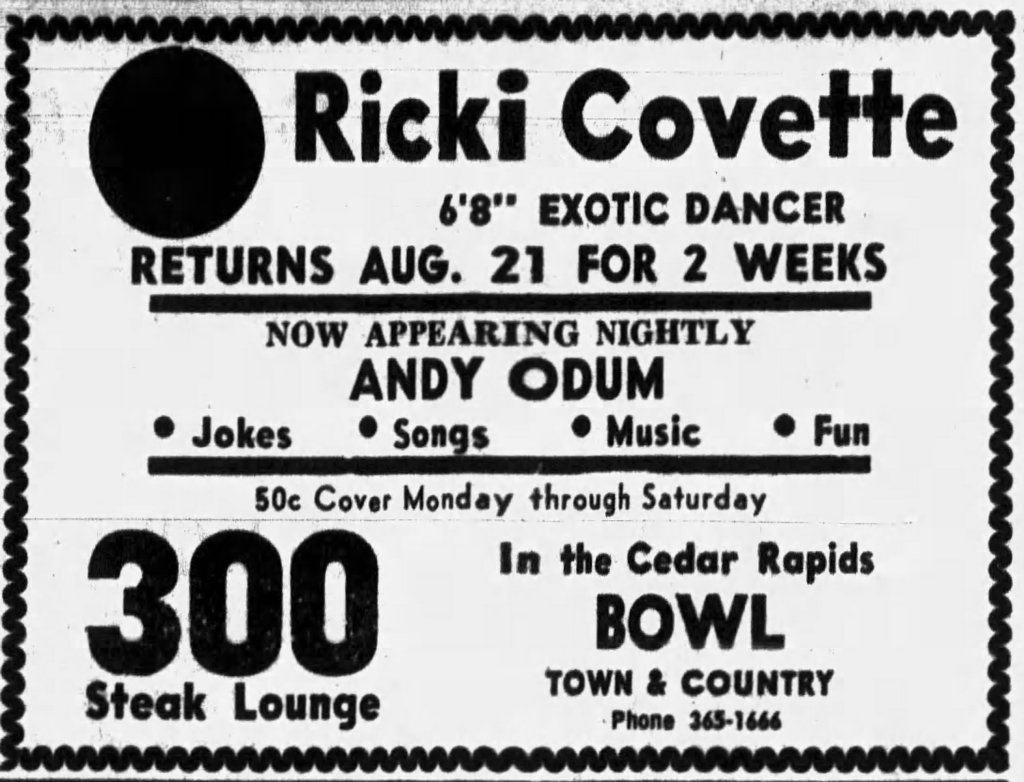
By the late 1960s, striptease had become a staple of cocktail lounges and supper clubs, moving away from the theatrical burlesque of earlier decades toward individualized acts that highlighted glamour and spectacle. Performers like Ricki Covette exemplified this shift: marketed as “exotic” and extraordinary, they catered to audiences seeking both sensuality and novelty in an era of loosening social norms.
1970s
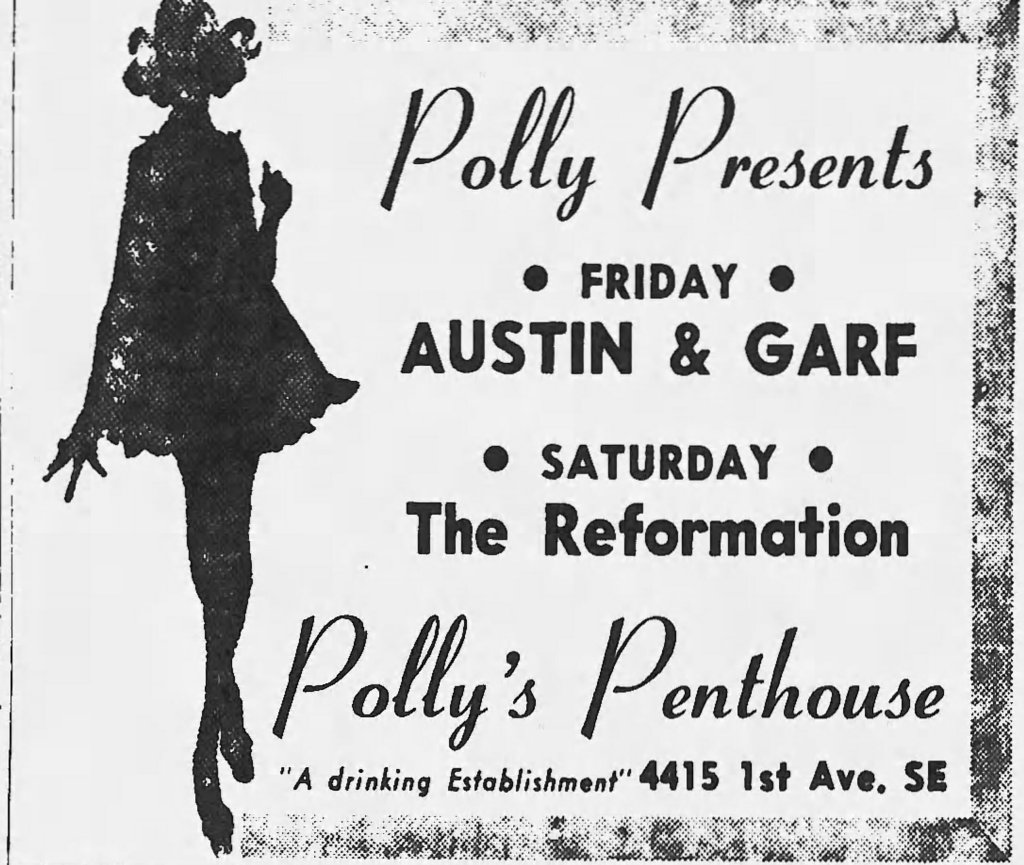
Across the country—and in Cedar Rapids—traditional burlesque stages gave way to go-go bars, topless dancing, and strip clubs, reflecting a shift from playful tease to overt eroticism. These venues often operated in lounges, bowling alley bars, and roadside establishments, advertising “exotic dancers” and “floor shows” that promised excitement and sensuality in a more intimate setting.
Unlike the elaborate productions of earlier decades, 1970s burlesque was stripped down—literally and figuratively. Performances focused on individual dancers rather than large ensembles, emphasizing spectacle through novelty acts, themed costumes, and increasingly daring routines. Ads from this era reveal how Cedar Rapids nightlife embraced these trends, marketing dancers as “exotic” and promoting adult entertainment as part of mainstream leisure.
Grindhouse Cinemas
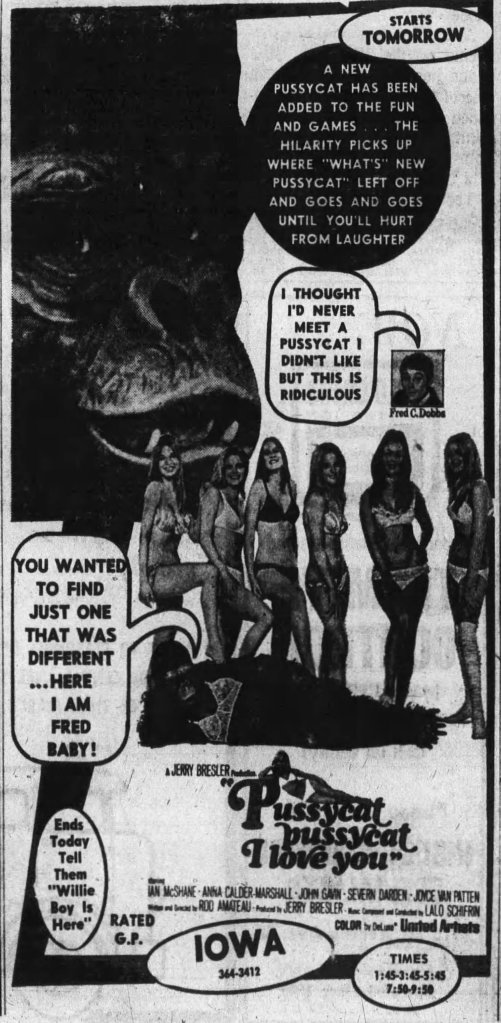
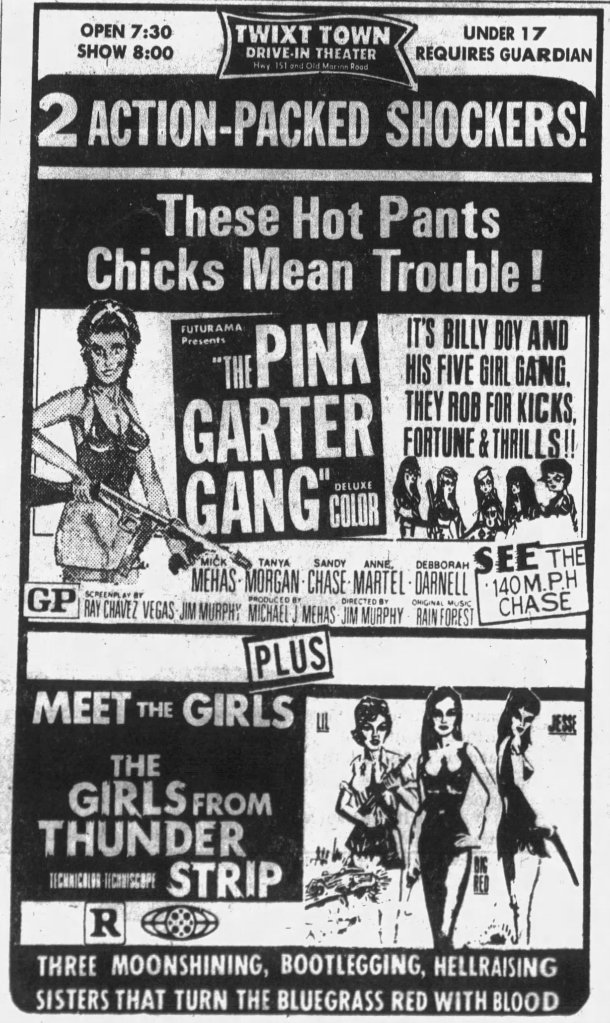
By the late 1960s and into the 1970s, the cultural landscape of American entertainment shifted dramatically with the emergence of grindhouse cinemas and adult movie theaters. These venues specialized in low-budget exploitation films, often featuring sensational themes—violence, sex, and taboo subjects—that mainstream theaters avoided.
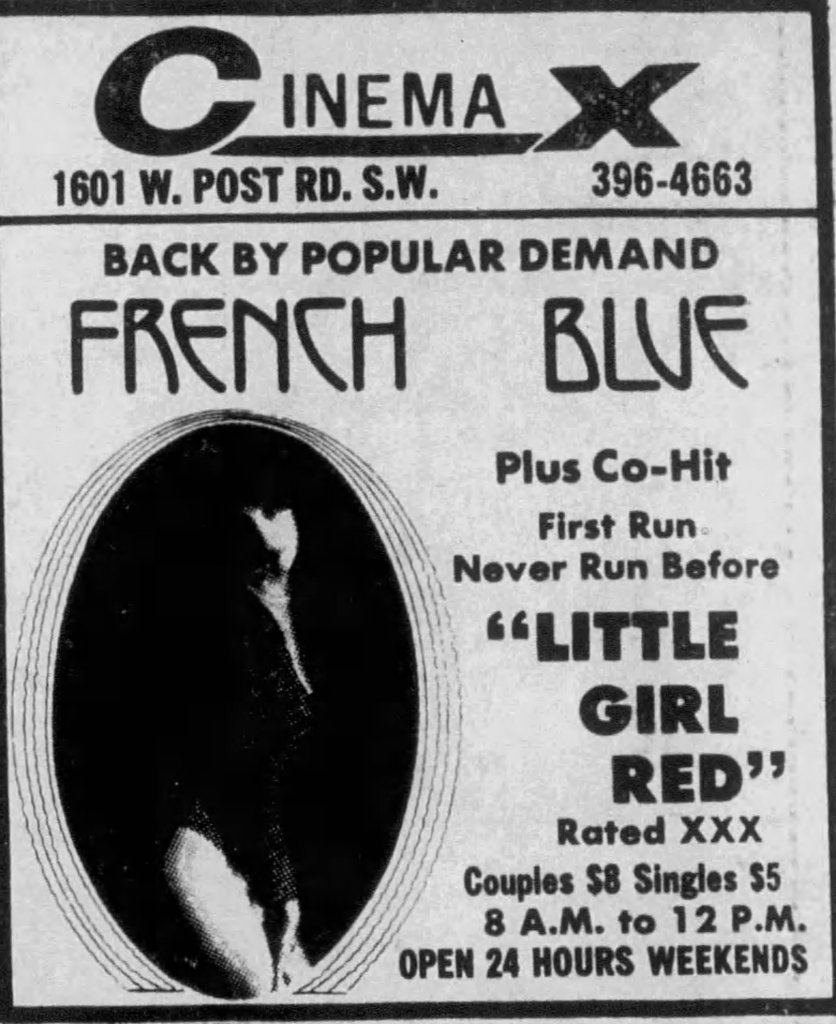
In many cities, including Cedar Rapids, older downtown theaters were repurposed for this booming market, reflecting both the loosening of obscenity laws and the growing appetite for explicit content during the sexual revolution.
Rise of Strip Clubs

Ricki Covette returned to Cedar Rapids in October 1970 to perform at The Flame Room’s Fox & Hounds Lounge. She was billed as the “World’s Tallest Exotic” at 6 feet 8 inches.
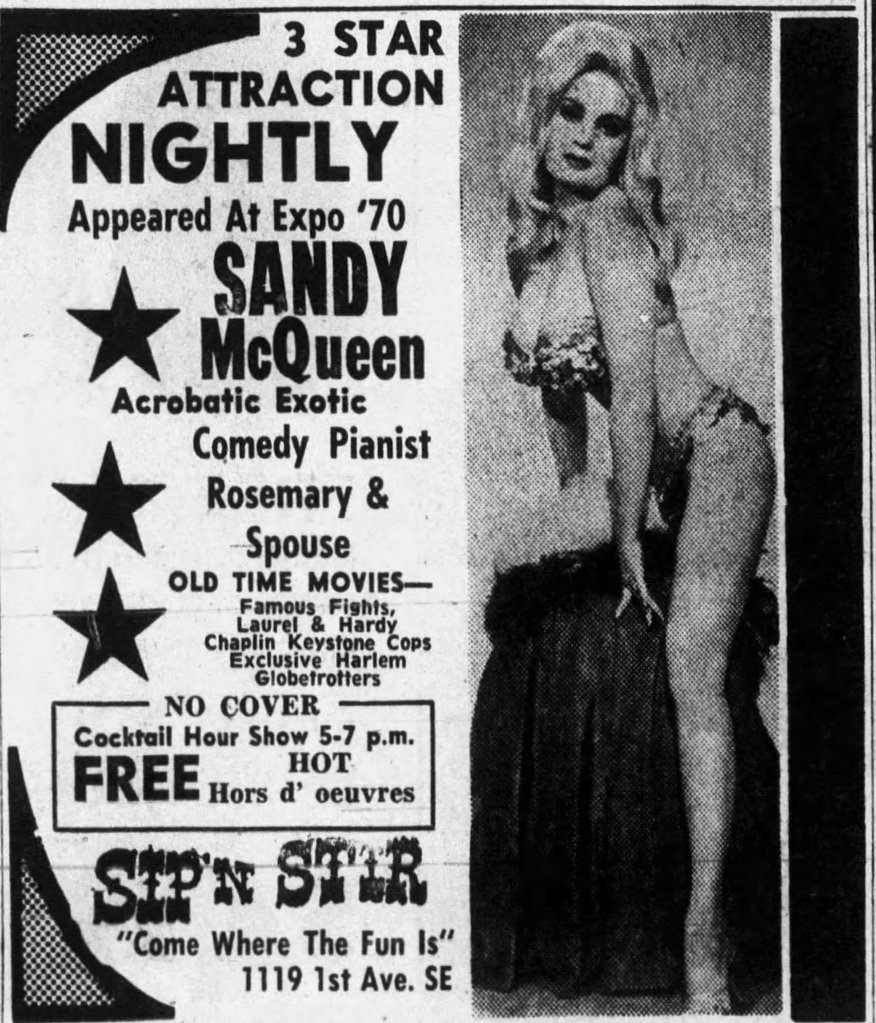
Travelers Lounge Room at the Sip ‘N Stir
The Travelers Lounge was located inside the Sip ‘N’ Stir at 1119 1st Ave SE. The club featured continuous exotic dancers.

Performers who graced the Sip ‘N Stir stage:
- Sandy Rudick – Acro-Exotic Interpretive Dancer
- Lynne Fontaine – Exotic Interpretive Dancer
- Miss Dee Dee Doll – Lovely Exotic Dancer-Strip
- Fahema – Belly Dancer
- Heave Lee – Exotic Dancer with a Devilish Spirit
- Sandy McQueen – Acrobatic Exotic
- Susie Slade – An Exceptional Beauty! Exotic Dancer
- Annie Fanny – The Lollypop Girl, Exotic Dancer
- Bambi – Exotic Dancer
- Andrea Leigh – Exotic Dancer
- Delphin Felice – Exotic Dancer
- The Fabulous Alicia – Exotic Interpretive Dancer
Ladies received 2 for 1 cocktails. There were 3 shows nightly with a special late night show at 1:00am. The bar also showed “old-time movies” or what they advertised as “fractured flickers.”
The Meeting Place at the Unique Motel
The Meeting Place was located inside the Unique Motel at 352 A Avenue NE. Their mottos were “Where Friends Meet” and “Home of the Headliners”. They featured 4 shows nightly and a new exotic dancer every week!
Performers that graced the stage of The Meeting Place from the 1970s to 1980s:
- Ellen Jaye’s Fashion Review – Latest Bikini, Lingerie and Mini Fashions
- Miss Nancy “S” – Exotic Dancer
- Lili Marlene – Sizzling Exotic Dancer
- Miss Angel Blue – Another ‘First’ for Cedar Rapids, Exotic Dancer
- Brandy Day – Exotic Fire Dancer Direct from Las Vegas
- Toni Dawn – The Tassel Girl
- Ericka – Fire and Samoa Sword Dancer
- Leslie Carroll – Exotic Dancer Direct from Jamaica
- Saki – Exotic
- Bridgette Du Chez – Exotic Dancer
- Christina – The Bronze Goddess, She Tops’ em all
- Susan Pritch and the Greatest – from Las Vegas
- Lisa Rivera
- Charisma
- Serpentina
- Rene London
- Donna Christie – Direct from Los Angeles
- Chici Sands – Direct from Australia
- Yevette
- Kitty Knight
- Jeannie Thomas – Direct from Las Vegas
- Ju Zsa
- Jo-Dee Kim
- Luna – Beautiful Exotic Strip Dancer “Black Magic Woman”…her love and fire burn with desire
- Loni – Strip Exotic Dancer
- Ronda Lee
- Honey Bee
- Miss Lisa Scott – Sepia Beauty
- Carmen Holiday – The Sexy One
- Brandy Scott – The Gal with the Million Dollar Gowns
- Vickie Renae – A Dancer’s Dancer
- Jasson – male exotic dancer
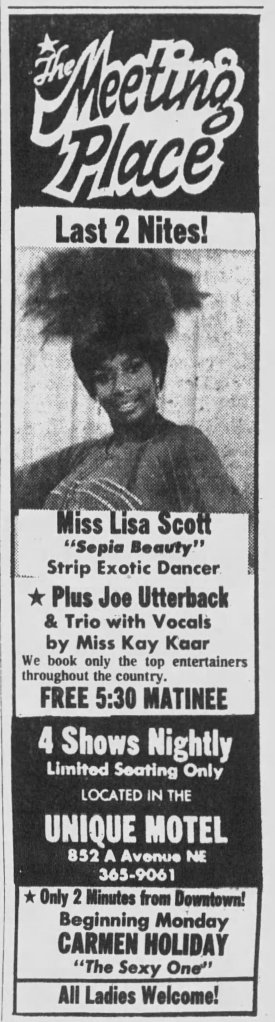
Their ads frequently called to men and women: “Attention, you professional men! Stop in on the way home for a cocktail and show. All ladies welcome!” or “Welcome! All Salesmen…and Conventioneers!”
Opinion Letter | September 1979

This era marked a clear departure from the theatrical burlesque of earlier decades, as performances shifted toward topless and fully nude dancing in venues designed for continuous shows rather than staged productions. The opinion letter above describes the push and pull many patrons were feeling as adult entertainment became more mainstream.
1980s
By the 1980s, strip clubs were firmly entrenched in mainstream nightlife, operating alongside bars and lounges, and their presence reflected broader societal trends toward commercialization of sexuality and the normalization of adult entertainment in leisure culture.
The Academy was an adult theater at 1601 W Post Road in the 1970s and 1980s.

Austin City Limits was located at 100 A Avenue NW and featured exotic dancers. In 1983 they advertised the show “Dirty Ernie” and his “male playboy exotic dancers”. It featured 4 shows a night with a $3 cover charge. Ernie was also booked at Doylar’s at 208 1/2 2nd Ave SE during the same period.
1990s+
Club Basix
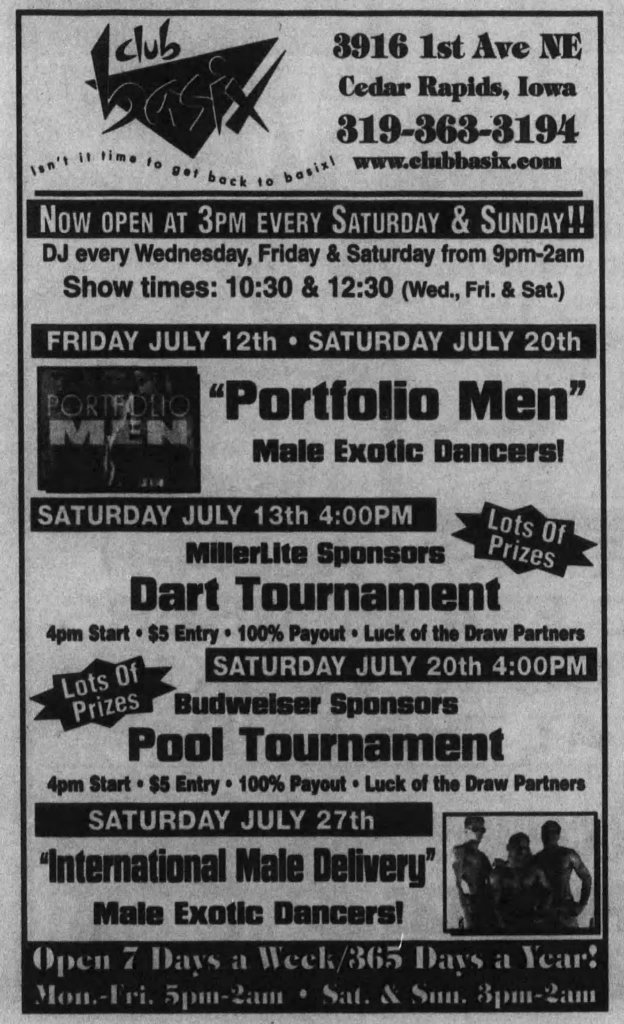
Club Basic was located at 3916 1st Ave NE. It featured male exotic dancers in shows such as “The Portfolio Men” and the “International Male Delivery” in the late 1990s and into the 2000s.
Pleasers Entertainment Scandal
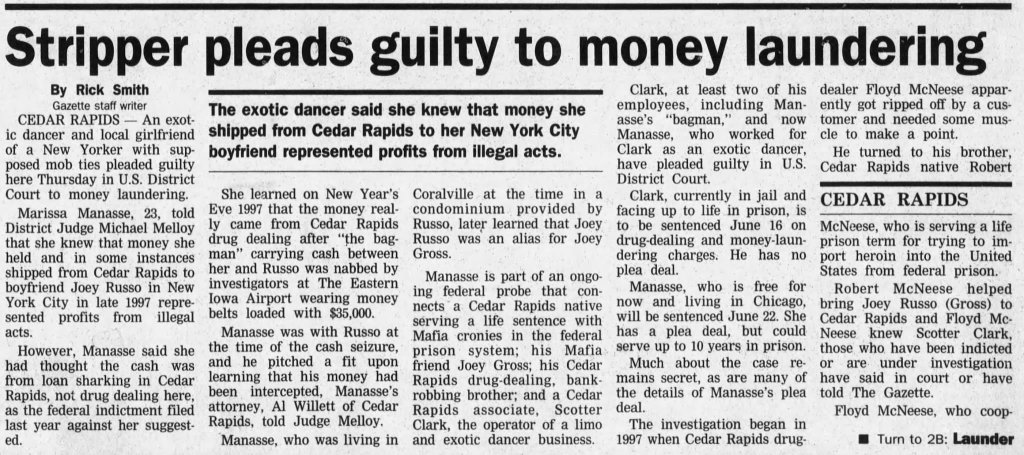
In March 2000, Cedar Rapids faced a sensational case linking exotic dancing to organized crime when a local performer pleaded guilty to money laundering in U.S. District Court. The dancer admitted that cash she transported from Cedar Rapids to New York City was tied to profits from illegal activities, including drug dealing and loan sharking. The investigation revealed connections to a broader criminal network involving aliases, luxury purchases, and interstate cash transfers. Federal prosecutors described the scheme as part of a Mafia-style operation, underscoring how adult entertainment businesses were sometimes entangled with illicit economies during this era. The case sparked public attention not only for its legal implications but also for what it revealed about the hidden intersections of nightlife, organized crime, and financial exploitation at the turn of the millennium.
True Crime & Woody’s Show Club
A judge in Cedar Rapids issued an arrest warrant for Mary Elizabeth Haglin, a former Washington High School substitute teacher, accused of having a sexual relationship with a 17-year-old male student between January and May while employed at the school. The warrant was requested after the former teacher violated pretrial release conditions by contacting the student, now 18, and meeting with him. If convicted, the individual faces up to two years in prison and 10 years on the sex offender registry.
The case gained media attention after the former teacher admitted to the relationship in interviews, including one with Crime Watch Daily, which revealed she then worked as an exotic dancer at Woody’s Show Club in Cedar Rapids. The school district began investigating in February 2016, initially finding rumors of the relationship unfounded, but later confirmed the allegations. The former teacher resigned in May after being removed from her position in January. (The Gazette. “Warrant issued in teacher sex case.” Trish Mehaffey. Page 16. September 16, 2016)
Sources:
Newspapers:
- The Gazette. “Stripper pleads guilty to money laundering.” Rick Smith. Page 11. March 31, 2000
- The Gazette. “Limo owner enters plea for drugs.” Rick Smith. Page 13. March 16, 2000
- The Gazette. “Mobster’s girl gets 16 months for money laundering in C.R.” Rick Smith. Page 11. July 22, 2000
- The Gazette. Ad for Club Basix. Page 68. July 10, 2002
- The Gazette. “Warrant issued in teacher sex case.” Trish Mehaffey. Page 16. September 16, 2016
- The Gazette. “Ted Lewis’ Show Coming Tuesday.” Page 10. February 28, 1936
- The Gazette. “Wanted” Page 4. December 13, 1890
- The Gazette. Ad for Ted Lewis and his Happiness Follies at the Paramount Theater. Page 10. February 28, 1936
- The Gazette. Ad for the Thornwood Garden & Ballroom. Page 14. July 1, 1937
- The Gazette. Ad for Hayes Music Box. Page 16. November 26, 1941
- The Gazette. Ad for Tito Guizar and his Singing Mariachis. Page 18. November 30, 1948
- The Gazette. Ad for Drive-In Movie Theater. Page 14. August 11, 1955
- The Globe Gazette. “Chicago Stripteaser Fined $200, Suspended Sentence for Dance.” Cedar Rapids, IA. Page 2. October 28, 1955
- The Gazette. “Lovely Mitzi” Page 7. May 27, 1958
- The Gazette. Ad for Montrose Hotel and Motor Inn. Page 22. February 23, 1968
- The Gazette. Ad for 300 Steak Lounge. Page 14. August 11, 1967
- The Gazette. Ad for the Iowa Theater. Page 18. March 24, 1970
- The Gazette. Ad for the Twixt Town Drive-In Theater. Page 39. September 15, 1971
- The Gazette. Ad for Cinema X. Page 29. June 29, 1977
- The Gazette. Ad for Ricki Covette. Page 41. October 18, 1970
- The Gazette. Ad for Polly’s Penthouse. Page 22. February 12, 1971
- The Gazette. Ad for the Meeting Place. Page 33. April 1, 1970
- The Gazette. “Letters to the Editor; Smut City” Page 6. September 24, 1979
- The Gazette. Ad for the Academy Theater. Page 22. April 16, 1982
- The Gazette. Page 68. July 10, 2002

Leave a comment