

Noma was a famous fan dancer in the 1930s. She lived and worked in Chicago, IL mostly. Noma was born in Bombay, East Indies (India) in 1910. Her mother’s name was Mahaji Mahinea. Her mother died when she was very young. Her father was a horse trainer for a wealthy family in Chicago. Noma learned how to ride horses at a young age.

(New Pittsburgh Courier. Page 11. November 18, 1933)
Caption reads, “Noma Gray: Sensational ‘fan dancer,’ is caught by a cameraman as she goes ‘over the hurdle’ on the riding range at Washington, D.C. Miss Gray is an accomplished horse-woman and whenever she gets an opportunity indulges in her favorite sports, riding and swimming. She is also an ardent baseball fan.”
At age 14, her father died. She was adopted by another family. Two years later, at 16 years old, she ran away from her adopted parents. She drove from Greenwich, CI to NYC. She was 5ft 4in tall and weighed 135lbs. She had long wavy black hair. She was an avid baseball fan and an equestrian.
Noma first got work posing as a model for the sculptor Paul Manship. She then went on to pose for W.T. Bender and Harrison Fisher. She had her first ‘big break’ when she was cast in the chorus of “Party Girl”, a Broadway musical. Shortly after this, she went into “colored theatricals” like “Brown Skin Models” by Irvin C. Miller.
She would soon pick up a pair of ostrich feather fans and perform the sensational fan dance, made popular by Sally Rand. Noma’s two fans cost between $200 and $300 ($4k-7k today) and were her greatest “fortune.” Her fans were made of ostrich feathers dyed pink and white shades.
Burlesque Beginnings | 1933
In the Fall of 1933, Noma headlined at the Roosevelt Theatre for their Gala stage show. She performed her “sensational fan dance.” She was called “the sepia rival of Sally Rand.” Added to the bill was Irvin C. Miller’s revised edition of “The Brown Skin Models” show. Noma was discovered by Walter O. Klein, a white manager, who managed only black entertainers, at the World’s Fair in Chicago. She was then booked for a showing at the Regal Theater in Chicago’s South Side.
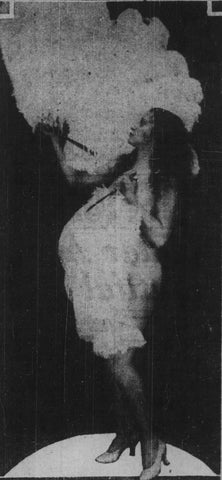
(New Pittsburgh Courier. Page 4. October 21, 1933)
On September 14, 1933 Noma was arrested after she performed her nude fan dance for an audience at the Metropolitan Theater in Chicago, IL. This was her fourth performance at the theater. She was arrested for her dancing and lack of clothing in Chicago. She lamented to the judge, “Chicago ‘purity’ officers know nothing about art—my talent and my symmetrical body are both works of art.” She was later released, being charged a fine.
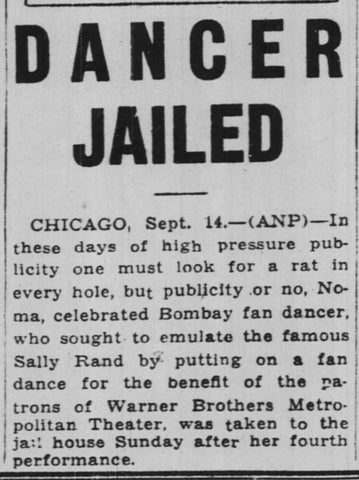
(New Pittsburgh Courier. “Dancer Jailed.” Page 4. September 16, 1933)
On November 9, 1933, Noma headed a vaudeville show that played at the Howard Theater in Washington, D.C. According to the New Pittsburgh Courier, the Tea Street House Theater was packed to the brim, setting record attendance numbers for any act who’d shown there. She was also called “The Bombay Fan Dancer”. Before performing in D.C. she had graced the stage of the Lafayette Theatre in NYC.
On November 16, 1933, Noma returned to New York City and performed at Club Harlem, previously known as Connie’s Inn. She then opened at the Mt. Morris Theater, did record numbers at the Harlem Opera House, and then continued to the Howard Theater in Washington on November 26th.
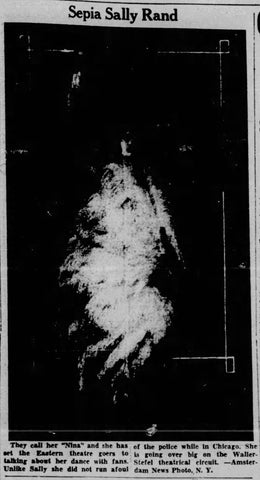
(The Call. “Sepia Sally Rand.” Page 3. December 1, 1933)
Caption reads, “They call her ‘Nina’ and she has set the Eastern theatre goers to talking about her dance with fans. Unlike Sally she did not run afoul of the police while in Chicago. She is going over big on the Waller-Stefel theatrical circuit.”
By December 1933, Washington D.C. critics were calling for Noma’s dance to be censored for vulgarity and obscenity. However, the manager of the Howard Theater, believed otherwise—her act was art. The newspaper critics had no sway over the massive crowds that attended each of Noma’s performances at the Howard.
1934
In February 1934, Noma broke with her manager, Walter Klein. He stated to the press, “Her artistic temperament became uncontrollable.” According to him, Noma had anger issues and would often “fight” with theater managers. Klein went on to manager another black fan dancer named Daisy DeLeon. Noma asserted that Klein was taking advantage of her and she hadn’t been paid during her 6-month contract.

(New Pittsburgh Courier. “Noma, Sepia Fan Dancer, Breaks with Manager.” Page 19. February 10, 1934)
She stated she was paid $75 ($1,795.49 today) at her first show in New York, at the Lafayette Theater, while Klein made $225 ($5,386.48 today) and a percentage over a certain gross for the engagement. Her next engagement at Lafayette, she agreed to receive less than last time, only $30 ($718.20 today). However, when the time came for the show to start, she refused to perform unless her full salary was paid. This started a battle between her and Klein. She also argued that Klein took her additional tips.

(Noma. New Pittsburgh Courier. Page 18. October 27, 1934)
Although she remained manager-less, Noma continued on performing her sensational fan dance for packed theaters in 1934. She traveled to Cleveland, OH for the first time and performed at the Cotton Club. She continued performing in New Jersey at the Wonder Bar. She also performed with Blanche Calloway, Cab Calloway’s sister and band leader, in her own right, at the Harlem Opera House in NYC.
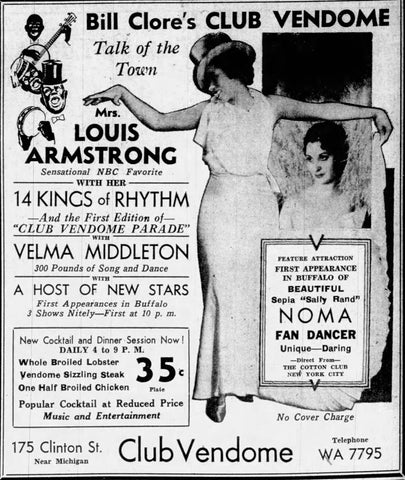
(The Buffalo Times. Advertisement for Mrs. Louis Armstrong and Noma. Page 25. December 7, 1934) Here Noma is listed as “unique” and “daring.”
1935-1940
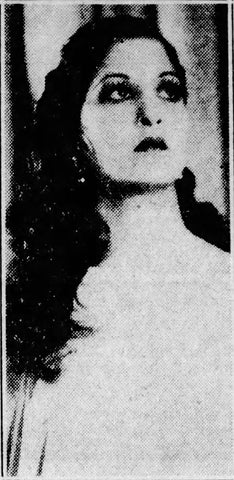
(Noma. Press of Atlantic City. Page 12. August 10, 1935)
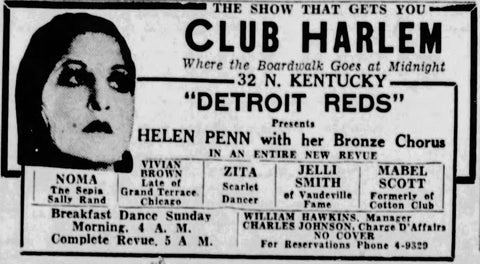
(Press of Atlantic City. Ad for Noma at Club Harlem. Page 11. August 17, 1935)
Noma continued to perform in the Midwest and East Coast through 1935. She performed at Club Harlem in Chicago in 1935. There she stars in “Harlem’s Follies Bergere.”
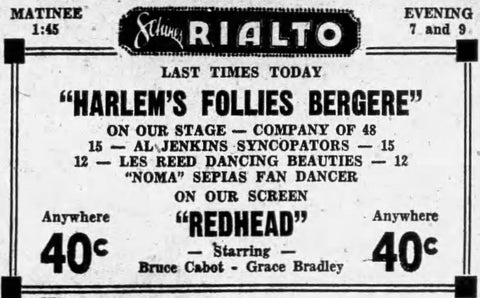
(The Post Star. Ad for Noma at Rialto Theatre. Page 18. March 18, 1935)
She performed at Club Harlem in New Jersey in 1936. She also performed at the Nixon Grand theater in Philly. She continued to perform with Blanche Calloway.
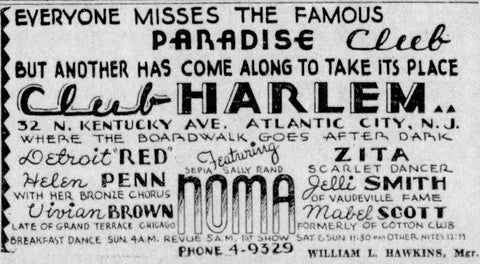
(Press of Atlantic City. Ad for Noma at Club Harlem. Page 8. August 25, 1935)
In 1937, she headlined at the Howard Theater in Washington D.C. In 1937 she goes on tour with Blanche Calloway’s troupe again. In the same year, she marries Harry Long, who goes on to create costumes for her. She debuted a sequins gown made by Long.
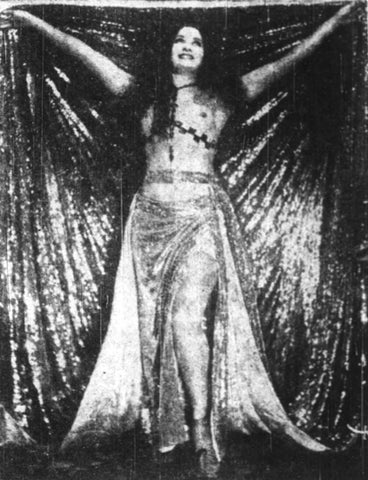
(Noma wearing a costume by husband Harry Long. New Pittsburgh Courier. Page 13. March 6, 1937)
In 1938, Blanche Calloway and her troupe perform at a benefit show for the Elks Club in Washington. Noma then went on to perform in Baltimore at the Club Astoria. She was often mistakenly called “Norma” in advertisements.
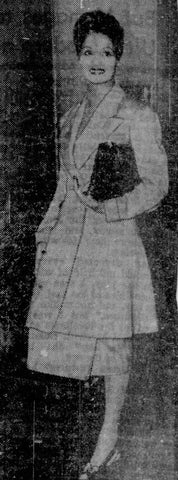
(Noma. The Afro American. Page 14. November 30, 1940)
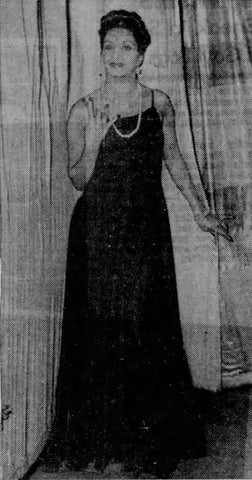
(Noma in her post-performance gown. The Afro American. Page 14. November 30, 1940)
Noma stops being mentioned as a fan dancer after 1940. She is then advertised as an “exotic dancer.” By 1940 she is married to Paul Belcher, a former Washingtonian. In January 1943 she performed in Portland, Maine. She was billed as an “exotic dancer.”
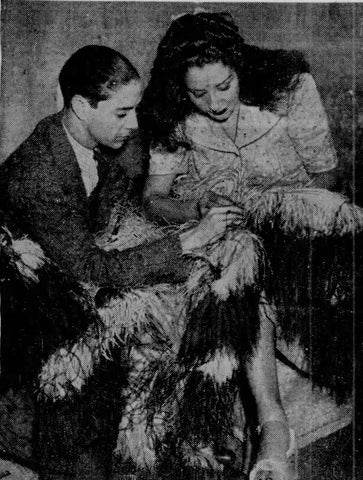
(Noma and her third husband, Paul Belcher, looking over her feather fans. The Afro American. Page 14. November 30, 1940)
In May 1945, a dancer named ‘Noma Mohiji’ was advertised as performing at the Diamond Mirror in Washington. The second name is close to her mother’s name “Mahaji Mahinea.”
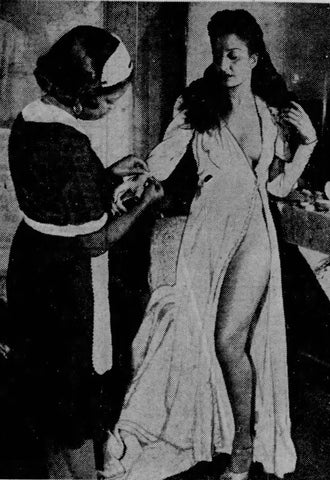
(Noma getting dressed in her dressing room. Page 14. November 30, 1940)
In January 1961, a dancer named “Noma” was advertised as an “Exotic Tassel Dancer’ in a floor show at Anchorage in Bangor, Maine. I’m unsure whether this is the same “Noma” as the 1930s “Sepia Fan Dancer.”
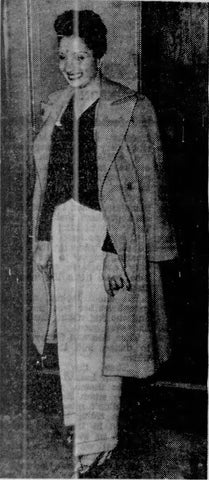
(Noma. The Afro American. Page 14. November 30, 1940)
Nicknames:
“The Bronze Venus”
“Sepia Rival of Sally Rand”
“The Sepia Sally Rand”
“The Bombay Fan Dancer”
Sources
Newspapers
- Evansville Courier. Ad for Noma at Lake Grove. Page 7. October 7, 1933
- New Pittsburgh Courier. “Dancer Jailed.” Chicago, IL. Page 4. September 16, 1933
- New Pittsburgh Courier.”…And Now You Can See Her!” Page 4. October 21, 1933
- New Pittsburgh Courier.”‘Noma’, Fan Dancer, To Head Roosevelt Show.” Page 16. October 21, 1933
- New Pittsburgh Courier. “Every Little Movement has a meaning all its own.” Page 9. October 28, 1933
- New Pittsburgh Courier. “Harlem Theatres Presenting Deluxe Revues; ‘Fan Dancer’ is a Sensation at the Lafayette.” Page 16. November 4, 1933
- New Pittsburgh Courier.”Rival Circuits Causing Plenty of Competition.” New York, NY. Page 16. November 11, 1933
- New Pittsburgh Courier.”Noma Heads Big Revue in Dee Cee.’ WM. Forsythe Jr. Page 16. November 11, 1933
- New Pittsburgh Courier. “Sepia Loveliness and a Figure Like Venus Combine to Make the Alluring Fan Dancer, Noma, A Sensation.” Page 11. November 18, 1933
- New Pittsburgh Courier.”They Called Noma’s Dance ‘Vulgar’ But the Crowds Liked It.” William Forsythe Jr. Page 16. December 9, 1933
- The Afro American. “Fan Dancer Stays at Howard Theatre Despite Dance Promoter’s Criticism.” Washington. Page 6. December 2, 1933
- The Black Dispatch. “Noma, Fan Dancer, Arrested.” Chicago, IL. Page 3. September 21, 1933
- The Call. “Sepia Sally Rand.” Page 3. December 1, 1933
- Times Herald. Ad for Noma at Howard Theater. page 8. November 25, 1933
- Buffalo Courier Express. Ad for Noma at Vendome. Page 21. November 23, 1934
- Buffalo Courier Express. “Directs Band.” Page 17. November 30, 1934
- Buffalo Courier Express. “Noma, Sepia Sally rand, Will Continue in Vendome Show.” Page 8. December 22, 1934
- New Pittsburgh Courier. “Noma, Sepia Fan Dancer, Breaks with Manager.” Earl J. Morris. Page 19. February 10, 1934
- New Pittsburgh Courier. “Noma, Sepia Fan Dancer, Answers Former Manager.” Page 18. February 17, 1934
- New Pittsburgh Courier. “Controversy.” Page 1. February 24, 1934
- New Pittsburgh Courier. “Cleveland.” Page 18. October 27, 1934
- New Pittsburgh Courier. “Cleveland’s Cotton Club Ranks with Best, and the Floor Show is Among Best.” Page 19. November 10, 1934
- Press of Atlantic City. Ad for Noma at Wonder Bar. Page 6. July 21, 1934
- Press of Atlantic City. “Places To Go in Atlantic City.” Page 6. July 21, 1934
- The Afro American. Ad for Noma at Howard Theatre. Page 11. June 2, 1934
- The Buffalo Times. Ad for Noma at Club Vendome. Page 25. December 7, 1934
- The Buffalo Times. “Vendome’s New Revue: Noma and Mrs. Louie Armstrong Are Featured.” Page 16. December 10, 1934
- The New York Age. “Blanche Calloway at Opera House Next Week.” Page 4. September 22, 1934
- New Pittsburgh Courier.’Grand Town Day & Night.” Earl J. Morris. Page 23. June 8, 1935
- Press of Atlantic City. “Club Harlem.” Page 9. August 7, 1935
- Press of Atlantic City. Ad for Noma at Club Harlem. Page 11. August 10, 1935
- Press of Atlantic City. “Sepia Sally Rand.” Page 12. August 10, 1935
- Press of Atlantic City. “Club Harlem.” Page 12. August 10, 1935
- Press of Atlantic City. Ad for Noma at Club Harlem. Page 11. August 17, 1935
- Press of Atlantic City. “Club Harlem.” Page 12. August 24, 1935
- Press of Atlantic City. Ad for Noma at Club Harlem. Page 8. August 25, 1935
- The Post Star. Ad for Noma at Rialto Theater. Page 14. March 14, 1935
- The Post Star. Ad for Noma at the Rialto Theater. Page 18. March 15, 1935
- The Post Star. “On Rialto Bill” Page 10. March 16, 1935
- The Post Star. “Fan Dance Tops Stage Program at the Rialto; ‘Noma,’ Talented Dancer Features in Harlem’s Follies Bergere Showing Today.” Page 7. March 18, 1935
- The Post Star. Ad for Noma at Rialto Theater. Page 7. March 18, 1935
- Press of Atlantic City. Ad for Noma at Club Harlem. Page 6. August 5, 1936
- The Philadelphia Inquirer. Ad for Noma at Nixon Grand Theater. Page 21. October 2, 1936
- New Pittsburgh Courier. “Sepia Sally rand is Darling of Broadway’s Smart Night Clubs.” Page 13. March 6, 1937
- New Pittsburgh Courier. “Wears Hubby’s Creations.” Page 13. March 6, 1937
- The Afro American. “Danny Logan and Band at Howard.” Page 10. January 23, 1937
- The Afro American. “$300 Plume for Fan Dancer.” Baltimore, MD. Page 19. January 23, 1937
- The Boston Globe. “Time Out! Southland to Open Tomorrow Night.” Page 29. March 31, 1937
- The Boston Globe. “Time Out! Southland Show Sensational.” Page 31. April 9, 1937
- Evening Express. “Elks to Sponsor Benefit Show.” Page 19. March 25, 1938
- The Afro American. Ad for Noma at club Astoria. Page 11. December 3, 1938
- The Afro American. “New Show at the Astoria Club.” Baltimore, MD. Page 10. December 10, 1938
- Washington Afro American. “Doing the Big Apple.” Buster Vodery. Page 11. November 5, 1938
- The Afro American. “Noma, Fan Dancer, Proves That It’s a Matter of Dress and Undress, with a slight Edge to Undress.” Page 14. November 30, 1940
- Portland Press Herald. Ad for Noma at the Colonial. Page 20. January 15, 1943
- Suburbanite Economist. Ad for Noma Niles at Moonlight Cafe. Chicago, IL. October 20, 1943
- The News. “New Show to Open at Diamond Mirror.” Page 29. May 25, 1945
- The Bangor Daily News. Ad for Noma at Anchorage Club. Page 4. January 6, 1961


Leave a comment