

Greene’s Opera House emerged as a cultural hub in Cedar Rapids during the late 19th century, offering residents access to touring theatrical companies and variety entertainment. By December 1888, the venue was hosting major productions such as Adonis by Rice and Dixey’s Big Burlesque Company, signaling its role in bringing popular burlesque and musical comedy to Iowa audiences.
A Brief History of Greene’s
Judge George Greene, one of Cedar Rapids’ founders and a former Iowa legislator and Supreme Court justice, decided late in life to build a new opera house to replace the Union Opera House. The Union’s location on the upper floors of its building was considered a serious fire hazard, prompting Greene to begin construction of a safer venue in 1879 next door. The old Union was later converted into a social hall called Woodward Hall.
Greene passed away in June 1880 before the new opera house was finished. His son, Calvin Greene, completed the project and managed the theater. Despite being unfinished, Greene’s Opera House opened on December 27, 1880, with The Bohemian Girl performed by the Emma Abbott Grand English Opera Company. Nearly 2,000 patrons attended, bundled in coats and gloves because the building lacked heat.
By August 1881, the opera house was fully completed and hailed as one of the finest theaters west of Chicago. Located on Second Street between First and A Avenues, the four-story building measured 60 by 142 feet and featured a pressed red brick façade accented with Milwaukee and black brick, cut stone, ornamental tile, and an iron cornice. Inside, it seated 1,600 in upholstered folding chairs, though its total capacity was 2,200. Initially, seating was on the second and third floors, with Dalzell’s restaurant occupying the first floor. First-floor seating was added after a major remodel in 1900.
The building was illuminated by hundreds of gas jets, including a massive sun burner with 92 jets in the dome, making the auditorium as bright as day. Fire safety was a priority, with fireproof construction, hoses throughout the building, and 42 exits. Greene’s was the only opera house west of Chicago to employ a stage carpenter.
For decades, Greene’s hosted two to three shows weekly, featuring top actors and productions. Notable performers included Edwin Booth, Marie Dressler, burlesquer Lillian Russell, Will Rogers, Al Jolson, and Cedar Rapids’ own Cherry Sisters. About 20 percent of its shows were musicals. By 1904, the theater boasted modern amenities such as steam-heated dressing rooms, electric lighting, and even electric curling irons for actresses.
After 1910, the rise of motion pictures and competition from larger city theaters led to a decline in opera house popularity. Greene’s closed abruptly in December 1921, leaving scheduled events stranded. The building was remodeled into a cinema at a cost of $35,000, but the venture failed. In 1934, it was converted into a parking garage for the Roosevelt Hotel.
By the late 1960s, the aging structure had deteriorated, developing a large crack in its back wall. Urban renewal plans called for its demolition, and on March 22, 1969, workers began tearing down what The Gazette called “the grandfather of Cedar Rapids theaters.”
Burlesque and Variety in the 1890–91 Season

A bound collection of Greene’s Opera House programs from the 1890–91 season reveals the prominence of burlesque in its offerings. Companies such as:
- Rentz-Santley Novelty and Burlesque Co. (A Sensation in Paradise, January 7, 1891)
- Sam T. Jack’s Creole Burlesque Co. (March 6, 1891)
- Kimball Opera & Burlesque Co. performed Corinne!
- Bolossy Kiralfy’s Water Queen – “a grand fantastic fairy spectacle in 3 acts”
- Henry E. Dixey & Players performed Adonis in 2 acts
- Merritt and Stanley’s Legitimate Minstrels
- The American Extravaganza Company in the operatic spectacular extravaganza Crystal Slipper, or Prince Preitiwitz and Little Cinderella
- Lilly Clay’s Colossal Gaiety Co.
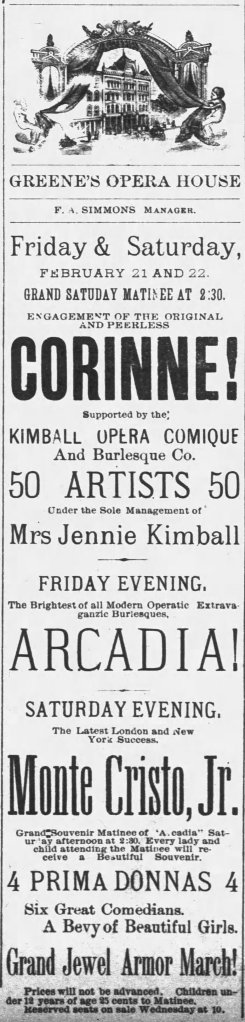
These troupes exemplify the era’s fascination with comedic burlesque and variety acts. The programs confirm that Greene’s was a key stop for touring companies, making Cedar Rapids part of a national entertainment circuit.
The London Gaiety Girls (1890)
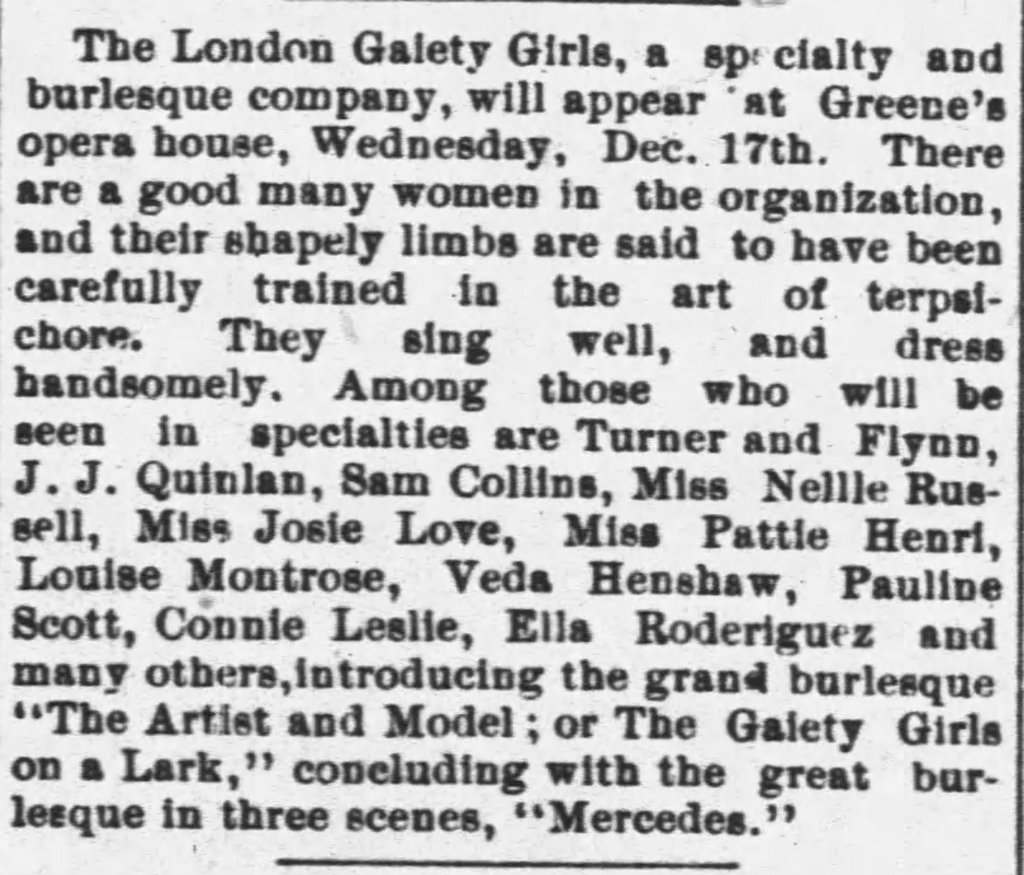
On December 17, 1890, Greene’s hosted the celebrated London Gaiety Girls, whose performance included the grand burlesque The Artist and Model; or the Gaiety Girls on Lark, followed by Mercedes. A preview in The Gazette (Dec. 12, 1890) noted:
“There are a good many women in the organization, and their shapely limbs are said to have been carefully trained in the art of terpsichore…introducing the grand burlesque ‘The Artist and Model; or the Gaiety Girls on Lark,’ concluding with the great burlesque in three scenes, ‘Mercedes.”
Sam T. Jack’s Creole Burlesque Company (1891)
Sam T. Jack, born in Pennsylvania in 1852, became a pioneering impresario of African-American vaudeville through his all-Black “Creole Show.” Greene’s Opera House hosted this groundbreaking troupe in March 1891, as confirmed by local advertisements. Their program featured lavish scenes and glittering burlesques such as The Beauty of the Nile, illustrating how Cedar Rapids audiences were exposed to innovative Black performance traditions during Reconstruction’s aftermath.

“From the scene of tropical luxury at the beginning of the program until the closing act of that glittering burlesque ‘The Beauty of the Nile.” -Boston Daily Globe. August 12, 1890
Operatic Burlesque and Musical Extravaganzas (1895–1902)

By October 1895, Greene’s staged Edwin Foy’s Little Robinson Crusoe, a three-act operatic burlesque parodying the classic tale. This trend of adapting popular stories into satirical productions continued into the early 20th century.
The Elks of Cedar Rapids Hosts Burlesque Circus (1899)
In April 1899, the Cedar Rapids Elks staged a lively Burlesque Circus at Greene’s Opera House, drawing thousands to a grand street parade that stretched over a mile. The procession featured ten bands, 56 wagons, and a colorful array of comic performers, aerial acts, and “funny clowns.” Spectators marveled at whimsical attractions like “wild beasts,” “freaks,” and two elaborate chariots humorously named Ben Her and Ben Him. The event was praised for its originality and spectacle, with local papers noting that no one left disappointed—a testament to the Elks’ flair for theatrical entertainment and community engagement.
The Wizard of Oz | Musical Extravaganza
In 1902, Greene’s presented The Wizard of Oz, billed as a “musical extravaganza.” Surviving programs from 1902–03 show a diverse lineup of minstrel shows, comedic burlesques, and novelty acts—underscoring the theatre’s role as a center for burlesque-adjacent entertainment.
Below are a selection of excerpts from pages of the Greene Opera House program:

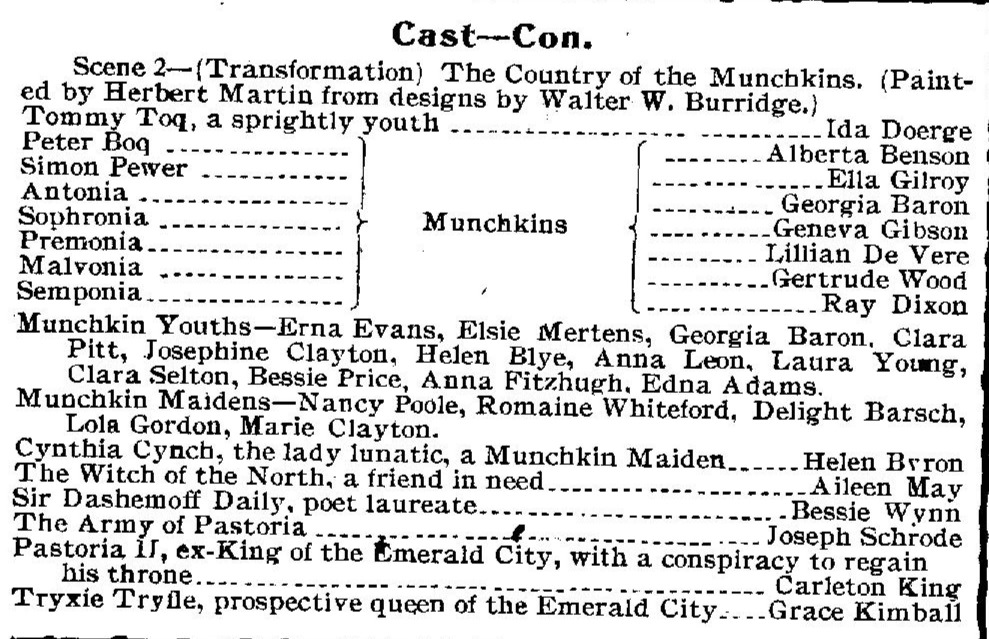
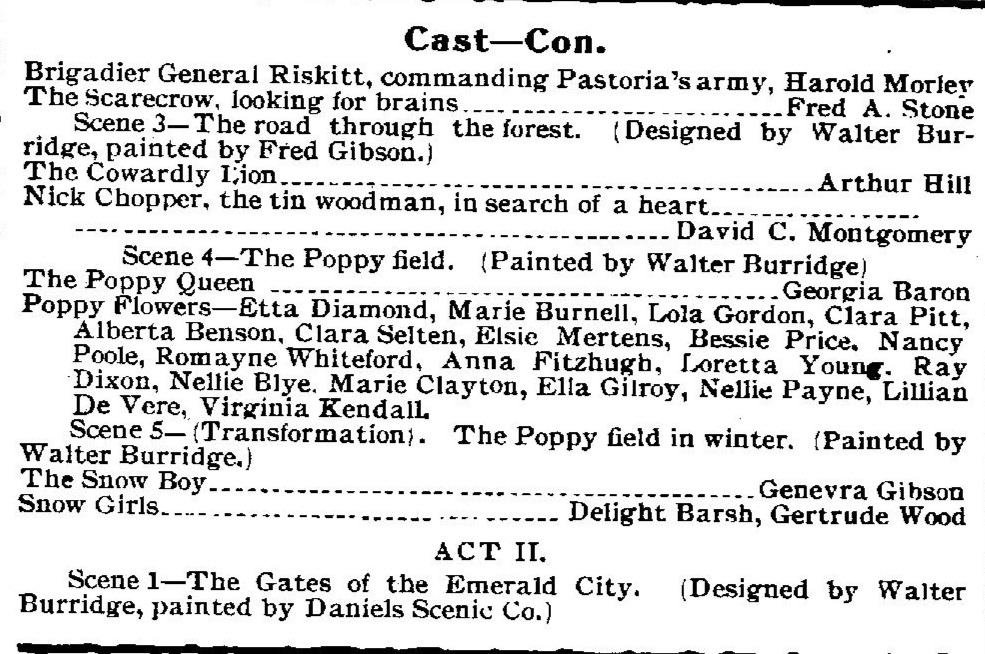
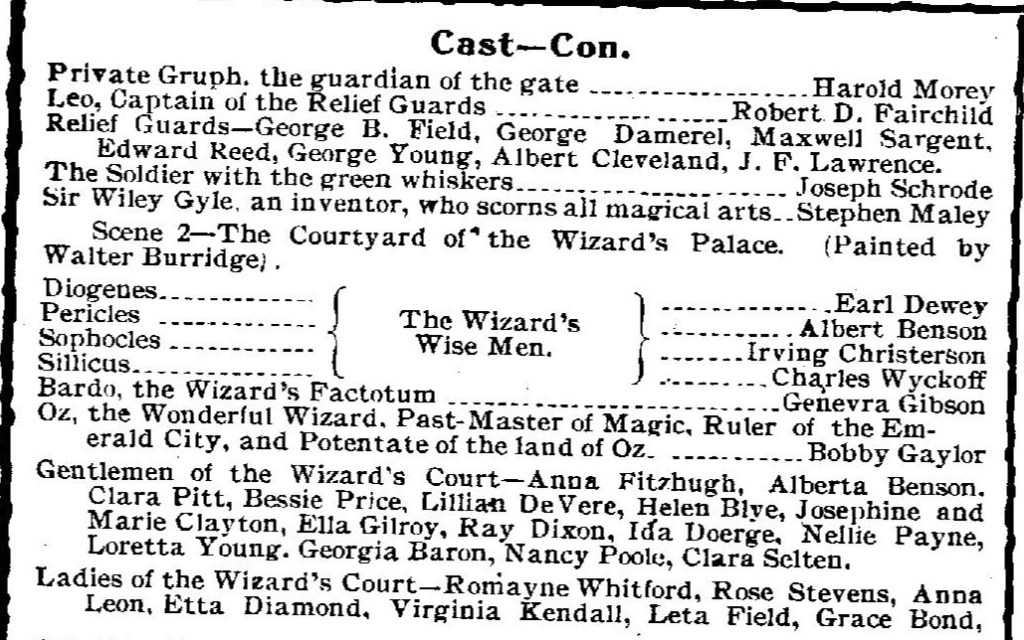

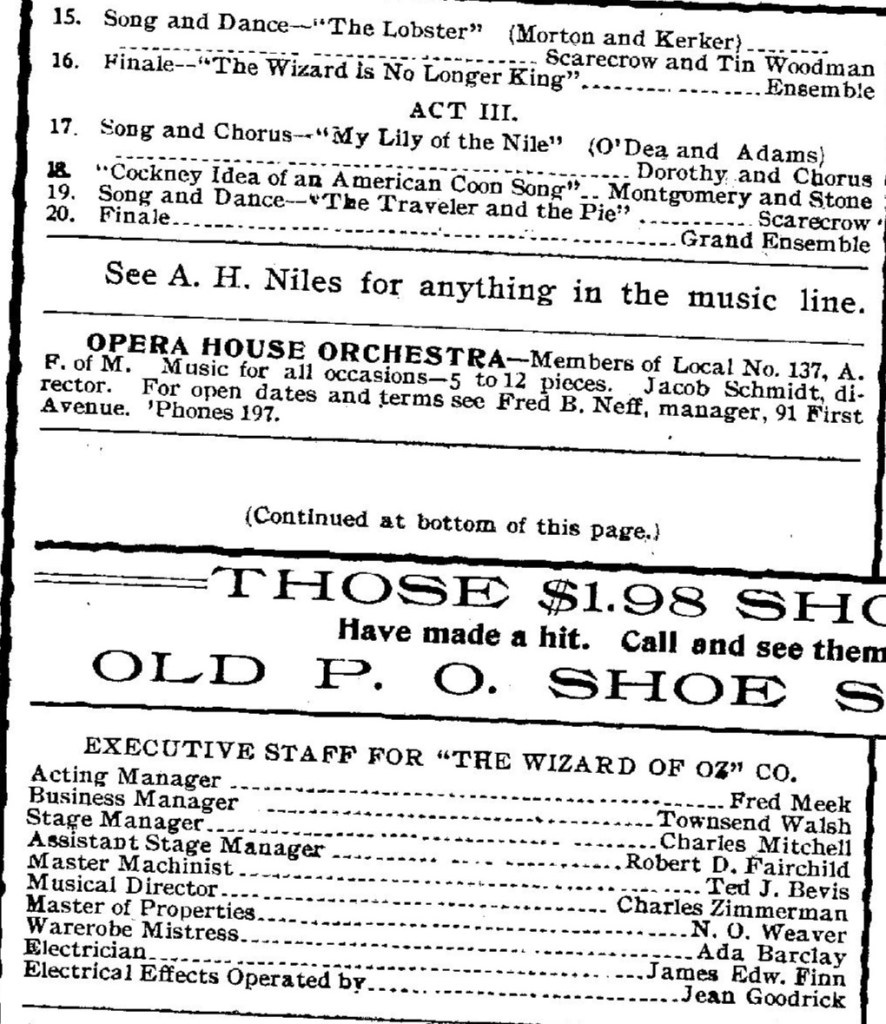
The 1908-1909 Season at Greene’s saw a slew of talented performers, such as The Boston Belles, The Princess Amusement Company Inc., and The Cedar Rapids Comic Opera Company.
The Monte Carlo Girls (1920)
Even into the 1920s, Greene’s maintained its burlesque tradition. In April 1920, the Monte Carlo Girls performed two-act burlesques—The College Girls and A Night in Monte Carlo. The production featured prima donna Sarah Hyatt, soubrette Kittie Warren, and a chorus of twenty dancers, including Flo Owen, known as the “Million Dollar Venus.”

Cultural Significance
Greene’s Opera House was more than a local stage—it was a reflection of America’s evolving entertainment landscape. From the late 19th century through the early 20th century, its programs reveal how Cedar Rapids audiences engaged with national trends in burlesque, musical comedy, and variety theatre. The venue introduced Iowans to groundbreaking performers like Sam T. Jack’s Creole Burlesque Company, which challenged racial barriers in theater, and to lavish productions such as The Wizard of Oz, which showcased the era’s appetite for spectacle and innovation.
Burlesque at Greene’s was not merely risqué humor; it was a dynamic art form blending satire, music, and dance—often parodying popular stories and cultural norms. These performances offered escapism, laughter, and glamour during periods of rapid social change, from the Gilded Age through the Jazz Age. By hosting acts like the London Gaiety Girls and the Monte Carlo Girls, Greene’s Opera House positioned Cedar Rapids as a participant in a nationwide circuit of theatrical entertainment.
Today, surviving programs and newspaper accounts serve as vivid reminders of Greene’s role in shaping local cultural identity. They document a time when live theatre was central to community life and when burlesque, in all its forms, helped define American popular culture. Greene’s Opera House stands as a testament to the vibrancy of Cedar Rapids’ performing arts heritage and its connection to broader narratives of race, gender, and performance in U.S. history.
Sources
Websites:
- Greene’s Opera House programmes, 1902, Cedar Rapids, Iowa – . . . The original musical extravaganza, The wizard of Oz. | Library of Congress
- Sam T. Jack – Wikipedia
- [Theatre programmes] | Library of Congress
- On this day in Linn County History:… – The History Center | Facebook
- Time Machine: Greene’s Opera House | The Gazette
- Image 1 of The black crook . . . a spectacular romance in four acts and sixteen tableaux. | Library of Congress
- Image 1 of The real singing show, The Boston Belles. | Library of Congress
Newspapers:
- The Gazette (Dec. 12, 1890; Mar. 4, 1891; Apr. 24, 1920)
- The Gazette. “This Circus Day.” Page 3. April 14, 1899
- The Gazette. “Will Give a Show.” Page 8. March 31, 1899
- The Gazette. Page 4. December 8, 1885
- The Gazette. Page 4. December 11, 1888
- The Gazette. “Lilly Clay.” Page 4. December 29, 1888
- The Gazette. Ad for Kimball Opera Comique and Burlesque Company at Greene’s Opera House. Page 4. February 21, 1890
- The Gazette. London Gaiety Girls. Page 2. December 12, 1890
- The Gazette. “A Monte Carlo Maid.” Page 10. April 24, 1920


Leave a reply to Exploring Burlesque History in Cedar Rapids, IA – Iona Fortune Burlesque Cancel reply