


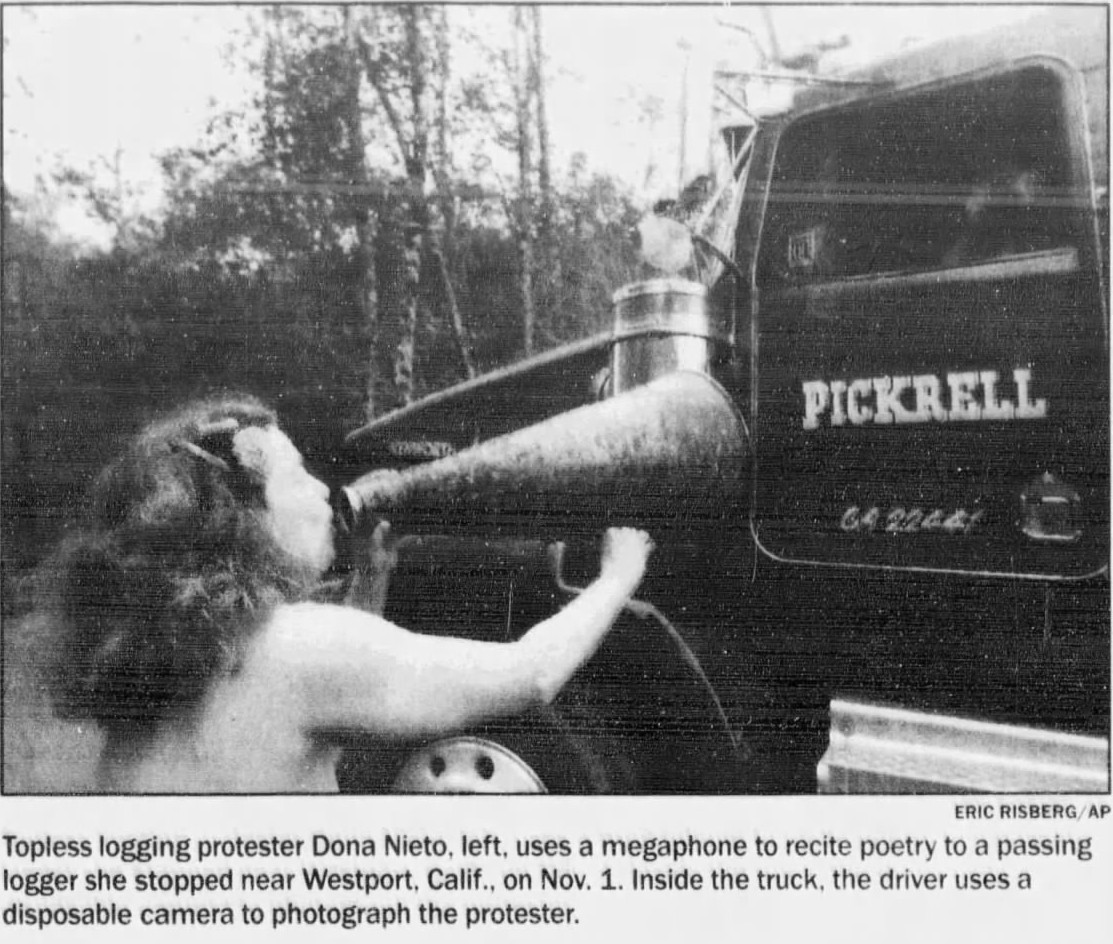
In the fall of 2000, logging roads in Northern California’s redwood country became the unlikely stage for one of the most striking environmental protests of the era. Amid the fog, mud, and grinding engines of logging trucks, activist and performance artist Dona Nieto stepped directly into the road, using nudity, poetry, and spectacle to interrupt business as usual. The press quickly dubbed her actions “Striptease for the Trees.”
Nieto’s protests were deliberately theatrical. Standing before oncoming trucks, she removed her top, raised a megaphone, and recited poetry addressing the drivers not as enemies, but as participants in a shared ecological crisis. The goal was not shock for its own sake. Rather, Nietzschean confrontation met gentle persuasion: halt the machine, create a pause, and force a moment of listening.

The tactic worked—at least temporarily. Truck drivers stopped, sometimes perplexed, sometimes amused, but often curious enough to hear what she had to say. Nieto was explicit that she was not demanding an absolute end to logging. Instead, she argued for restraint: selective cutting, preservation of ancient groves, and an acknowledgment that limitless extraction carried irreversible consequences.
Traditional avenues of protest—press releases, lawsuits, and policy debates—had failed to capture widespread attention. By contrast, a topless poet standing in the road guaranteed coverage. Newspapers, television programs, and documentary filmmakers took notice. For Nieto, media attention was not a side effect; it was a tool. If saving the forest required embodying vulnerability and putting one’s own body on the line, she was willing to do so.

Critics questioned whether such tactics trivialized the environmental movement or generated the “wrong kind” of publicity. Nieto countered that discomfort was precisely the point. Logging practices that clearcut old-growth redwoods were themselves extreme, yet normalized. Her protest inverted that logic, making the destruction visible and the familiar strange.
“Striptease for the Trees” occupies a unique place at the crossroads of environmental activism, performance art, and ecofeminist protest. It reminds us that social movements are not only fought in courtrooms and legislatures, but also staged—sometimes literally—in the dirt, using the body as both message and medium.
Eco‑Performance Protest: A Brief Historical Context
Dona Nieto’s “Striptease for the Trees” did not emerge in a vacuum. Her actions belong to a longer tradition of eco‑performance protest, in which activists use their bodies, ritual, and theatrical disruption to confront environmental destruction when conventional advocacy fails.
This lineage can be traced back at least to the countercultural environmental movements of the 1960s and 1970s, when direct action became central to ecological resistance. Groups such as Greenpeace deployed spectacle—small boats interposing themselves between whales and harpoons, activists chaining themselves to nuclear test sites—to create images that were morally arresting and impossible to ignore. These acts functioned as performances for the media as much as as physical interventions, turning protest into a visual language the public could grasp instantly.
At the same time, artists and feminists were exploring the body as a site of political meaning. Performance artists like Ana Mendieta, Carolee Schneemann, and Yoko Ono used nudity, vulnerability, and ritual to challenge systems of power, including patriarchal control over both bodies and land. Mendieta’s earth-body works in particular—where her form was traced, embedded, or dissolved into natural landscapes—helped crystallize an ecofeminist aesthetic that linked bodily harm to environmental violence.

By the 1980s and 1990s, these threads converged in the rise of eco‑feminist direct action. Movements such as the women-led protests at Greenham Common in the UK or forest defense actions in the Pacific Northwest, explicitly framed environmental protection as a defense of life, care, and interdependence. The human body—especially the bare, unprotected body—became a strategic symbol of fragility set against industrial machinery.
Forest defense campaigns, including tree-sits and road blockades, leaned heavily on performative tactics. Activists sang, staged rituals, dressed in symbolic costumes, and sometimes adopted mythic or archetypal identities—“tree spirits,” “forest mothers,” or guardians of the land. These performances were not meant to entertain but to reframe extractive practices as violations, rendering visible the imbalance between living ecosystems and industrial force.
Nieto’s protest fits squarely within this tradition, but with a distinct emphasis on interruption and dialogue. Unlike confrontational sabotage, her stripping and poetry forced logging operations to pause without violence, compelling workers to encounter not just resistance but reflection. The nudity was symbolic rather than erotic: a metaphor for exposure, honesty, and the stripping away of illusions about endless natural resources.
Importantly, eco‑performance protests have often provoked controversy precisely because they blur boundaries—between art and activism, seriousness and spectacle, rational argument and embodied plea. Critics frequently dismiss them as unserious or counterproductive. Yet historically, these tactics have succeeded in one crucial way: they generate attention at points where polite protest fails.
“Striptease for the Trees” thus belongs to a mode of resistance that treats the body as both medium and message. In standing bare before a logging truck, Nieto drew on decades of eco‑performance activism that insisted environmental destruction is not an abstract issue, but one that cuts directly into flesh, memory, and future survival.
Indigenous Protest, Performance, and Intersectionality
Indigenous environmental protest has long employed performance, ceremony, and bodily presence, but its logic differs fundamentally from many Western activism. Rather than using spectacle primarily to attract media attention, Indigenous protest often draws from relational worldviews in which land, water, ancestors, and living bodies are inseparable.
Protest as Ceremony and Continuity
During the twentieth century, Indigenous resistance movements such as the Red Power movement deliberately used embodied, visible actions—occupations, marches, and ritual gatherings—to reclaim land and treaty rights. Events like the Occupation of Alcatraz (1969–1971) and Wounded Knee (1973) were framed not only as political confrontations but as acts of spiritual and cultural resurgence, grounded in Indigenous law and kinship to place.
This fusion of resistance and ceremony continues into the present. At international climate summits and extraction sites, Indigenous activists frequently perform songs, dances, and prayers at protest sites—actions that are often misread by outsiders as symbolic gestures rather than legally and spiritually grounded assertions of responsibility to land.
Standing Rock and the Reframing of Environmental Protest
The Standing Rock / #NoDAPL movement (2016–2017) marked a watershed moment in global environmental activism. Indigenous participants consistently resisted the label “protesters,” instead identifying as water protectors, emphasizing reciprocal obligation rather than opposition. Camps at Standing Rock were structured around prayer, collective cooking, and ceremony; the body at the barricade was not a theatrical prop, but a shield for water, burial grounds, and future generations.
Standing Rock also revealed the intersectionality inherent in Indigenous environmental activism: land theft, environmental destruction, police militarization, treaty violations, and the disproportionate targeting of Indigenous women and youth were understood as interconnected rather than separate issues.
Idle No More and Performance as Relational Politics
A striking example of Indigenous eco‑performance is Idle No More, the women‑led movement that emerged in Canada in 2012. Idle No More organizers used round dances in public spaces—malls, transit hubs, government buildings—as a form of peaceful interruption. These actions blended flash‑mob tactics with traditional Indigenous dance, turning everyday commercial spaces into sites of collective responsibility and visibility.
Importantly, Idle No More centered Indigenous women’s leadership, linking environmental deregulation to gendered violence, colonial governance, and attacks on water. Intersectionality was not a borrowed academic framework here but a lived reality: sovereignty, gender justice, ecology, and community survival were addressed simultaneously.
Intersectionality Beyond Metaphor
Intersectionality, a concept articulated by legal scholar Kimberlé Crenshaw, has particular resonance in Indigenous environmental movements because colonialism itself operates through overlapping systems of oppression—racial, gendered, territorial, and ecological. Indigenous feminists and climate organizers emphasize that environmental harm cannot be separated from the historical targeting of Indigenous women, two‑spirit people, and knowledge systems.
Organizations such as Indigenous Climate Action explicitly frame climate activism as intersectional work, insisting that justice requires Indigenous sovereignty, gender equity, disability justice, and economic equity to be addressed together rather than sequentially or symbolically.
Implications for Eco‑Performance Protest
Placing “Striptease for the Trees” alongside Indigenous eco‑performance traditions highlights an important distinction. While Western eco‑performance often seeks to shock audiences into awareness, Indigenous protest tends to assert continuity—We are still here, and the land remembers Us. Where nudity or bodily vulnerability in settler protest may be metaphorical, Indigenous embodied protest frequently carries legal, spiritual, and ancestral authority.
Recognizing this difference does not diminish acts like Dona Nieto’s. Instead, it situates them within a broader ecosystem of resistance while underscoring the need to credit and learn from Indigenous frameworks that have long linked body, land, and activism without separating art from survival.
Sources
- American Archive of Public Broadcasting. Native Narratives: The American Indian Movement. American Archive of Public Broadcasting, americanarchive.org/exhibits/native-narratives/aim.
- Baker, Elizabeth Ann. To Be Magic: The Art of Ana Mendieta Through an Ecofeminist Lens. 2016. University of Central Florida, Honors Undergraduate Thesis, STARS, stars.library.ucf.edu/honorstheses/3.
- Blakemore, Erin. “The Radical History of the Red Power Movement’s Fight for Native American Sovereignty.” National Geographic, 25 Nov. 2020, http://www.nationalgeographic.com/history/article/red-power-movement-radical-fight-native-american-sovereignty.
- Beautiful Trouble. “Round Dance Revolution.” Beautiful Trouble, beautifultrouble.org/toolbox/tool/round-dance-revolution/.
- Crenshaw, Kimberlé. “Mapping the Margins: Intersectionality, Identity Politics, and Violence Against Women of Color.” Stanford Law Review, vol. 43, no. 6, 1989, pp. 1241–1299.
- Encyclopaedia Britannica. “Standing Rock Protests.” Britannica, http://www.britannica.com/event/Standing-Rock-protests.
- Hemispheric Institute of Performance and Politics. “Idle No More Round Dance Revolution.” e‑misférica, hemisphericinstitute.org/en/emisferica-121-caribbean-rasanblaj/12-1-dossier/e-121-dossier-crowe-no-more-round-dance-revolution.html.
- Indian Law Resource Center. “Violence Against Rural Indigenous Women.” Indian Law Resource Center, indianlaw.org/news/violence-against-rural-indigenous-women-brazil-guatemala-peru-and-us.
- Indigenous Climate Action. “Intersectionality.” Indigenous Climate Action, http://www.indigenousclimateaction.com/intersectionality.
- Indianz.com. “Reflecting on the Milestone Pipeline Protest Movement at Standing Rock.” Indianz.com, 30 Apr. 2026, indianz.com/News/2026/04/30/native-america-callling-reflecting-on-the-milestone-pipeline-protest-movement-at-standing-rock/.
- NRDC. “The Dakota Access Pipeline: What You Need to Know.” Natural Resources Defense Council, 12 June 2024, http://www.nrdc.org/stories/dakota-access-pipeline-what-you-need-know.
- “Idle No More.” Wikipedia, Wikimedia Foundation, en.wikipedia.org/wiki/Idle_No_More.
- “Red Power Movement.” Wikipedia, Wikimedia Foundation, en.wikipedia.org/wiki/Red_Power_movement.
- UN Women. “Intersectional Feminism: What It Means and Why It Matters Right Now.” UN Women, 12 June 2025, http://www.unwomen.org/en/articles/explainer/intersectional-feminism-what-it-means-and-why-it-matters-right-now.
- Viso, Olga M. Ana Mendieta: Earth Body, Sculpture and Performance, 1972–1985. Hatje Cantz, 2004.
- Yale Energy History. “Standing Rock Protests.” Yale University, energyhistory.yale.edu/standing-rock-protests/.
Leave a Reply